
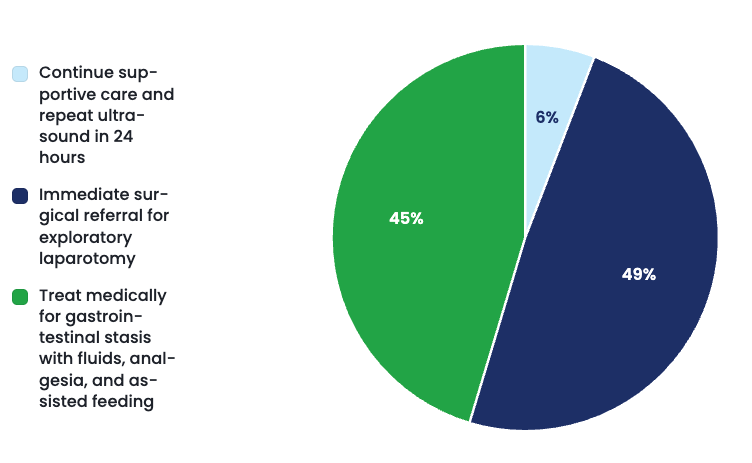
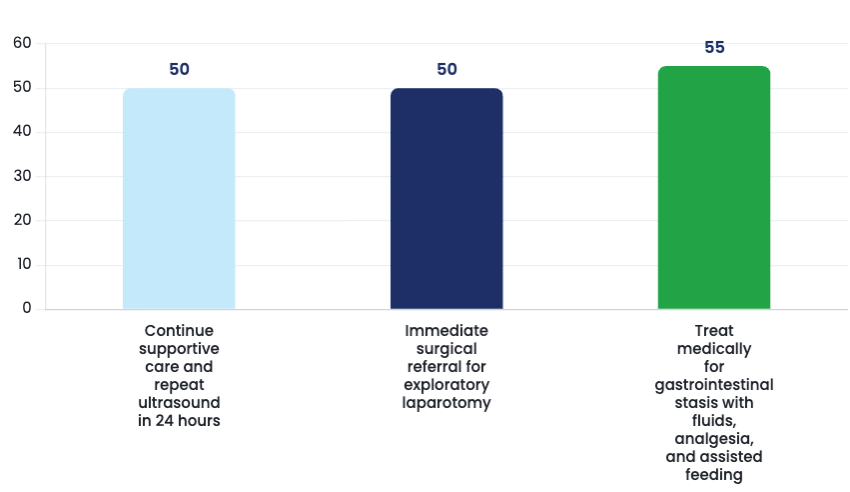
This week’s rabbit case created a much closer split, but the largest group of respondents landed with the specialists. Forty-nine percent of DVMs selected immediate surgical referral, which aligns with the recommendation from our exotics specialists. While the presenting signs could easily be mistaken for routine GI stasis, the combination of significant abdominal pain, liver enzyme abnormalities, anemia, and reduced Doppler blood flow to an enlarged liver lobe pointed toward liver lobe torsion—a surgical emergency rather than a medical GI case.
GI Stasis in Rabbits… or Something More?
This Week’s Results (August 3-7)
Preferred Treatment by Responding DVMs
Effectiveness of Treatments
How a General Practitioner Might Approach This Case
Rabbits presenting with anorexia and decreased fecal production are seen in practices every day.
The overwhelming majority are diagnosed with gastrointestinal stasis—a syndrome that develops secondary to stress, pain, diet, systemic illness, or another underlying disease.
Because GI stasis is so common, it is understandable that many clinicians immediately begin treatment with:
- Intravenous or subcutaneous fluids
- Analgesics
- Nutritional support
- Prokinetics when appropriate
In many rabbits, this approach is exactly what is needed.
However, exotics specialists are careful to remember one important principle:
GI stasis is rarely the primary disease.
Instead, it is usually the consequence of another painful condition.
The challenge is identifying that condition before supportive care alone allows it to worsen.
How Specialists Typically View This Case
From an exotics surgery perspective, the most appropriate recommendation is:
Immediate Surgical Referral for Exploratory Laparotomy
The ultrasound findings dramatically change this case.
Rather than simply documenting gastrointestinal slowing, the imaging suggests a far less common—but potentially life-threatening—condition:
Liver lobe torsion.
Although uncommon, liver lobe torsion has become increasingly recognized in pet rabbits, particularly young to middle-aged rabbits of several breeds, including Mini Lops.
Unfortunately, early clinical signs often look almost identical to routine GI stasis.
The Clues Are Hidden in Plain Sight
The decreased appetite.
The reduced fecal output.
The lethargy.
The abdominal pain.
Every one of these findings fits GI stasis.
But several additional findings should make clinicians pause.
The elevated liver enzymes suggest hepatocellular injury rather than simple gastrointestinal dysfunction.
The mild regenerative anemia raises concern for internal hemorrhage or vascular compromise.
Perhaps most importantly, Doppler ultrasound demonstrates minimal blood flow to an enlarged liver lobe.
That finding should immediately raise suspicion for vascular torsion.
Unlike uncomplicated GI stasis, liver lobe torsion is a surgical disease.
Why Liver Lobe Torsion Causes GI Stasis
Many clinicians think of GI stasis as a primary gastrointestinal disorder.
In reality, rabbits stop eating whenever they experience significant pain.
As the gastrointestinal tract slows, gas accumulates.
Motility decreases further.
The rabbit becomes progressively dehydrated.
Within hours, the secondary effects of ileus begin to dominate the clinical picture.
In cases of liver lobe torsion, the gastrointestinal signs are often what owners notice first.
The underlying hepatic disease remains hidden until advanced imaging is performed.
Why Surgery Is Recommended
Once torsion occurs, blood supply to the affected liver lobe becomes compromised.
Initially, venous drainage is obstructed.
As pressure increases, arterial perfusion also decreases.
The affected tissue rapidly becomes:
- Congested
- Ischemic
- Necrotic
No amount of fluid therapy or assisted feeding can restore blood flow.
The definitive treatment is surgical removal of the affected liver lobe.
Fortunately, rabbits generally tolerate partial hepatectomy well when surgery is performed before widespread necrosis or shock develops.
Why Not Treat as GI Stasis?
This is easily the most tempting answer.
Nearly every rabbit with liver lobe torsion initially appears to have uncomplicated GI stasis.
Supportive care is certainly appropriate as stabilization before surgery.
However, supportive care alone does not correct the underlying problem.
If clinicians assume the liver changes are secondary rather than primary, surgery may be delayed while the rabbit continues to deteriorate.
Why Not Repeat Ultrasound Tomorrow?
Waiting another 24 hours may seem reasonable if the rabbit appears stable.
Unfortunately, vascular compromise rarely improves spontaneously.
Continued ischemia increases the likelihood of:
- Hepatic necrosis
- Hemorrhage
- Septic complications
- Progressive shock
Early surgical intervention is associated with substantially better outcomes than delayed surgery.
Why Not Discharge with Medical Therapy?
Discharging a rabbit with suspected liver lobe torsion carries considerable risk.
Owners may temporarily observe slight improvement after fluids and pain control, creating false reassurance.
Meanwhile, the underlying vascular obstruction continues.
Many rabbits return only after becoming profoundly unstable.
By that stage, anesthesia and surgery become considerably higher risk.
Practical Application in General Practice
When evaluating rabbits with suspected GI stasis, specialists encourage clinicians to ask four questions.
Does this rabbit have more pain than expected?
Marked cranial abdominal pain should prompt investigation beyond primary ileus.
Are liver enzymes elevated?
Although nonspecific, unexplained elevations should raise suspicion for hepatic disease.
Does ultrasound demonstrate abnormal liver architecture?
A rounded, enlarged, heterogeneous liver lobe with absent or markedly reduced Doppler blood flow is highly concerning for torsion.
Is GI stasis the diagnosis—or the consequence?
This is perhaps the most important question.
In rabbits, gastrointestinal stasis is usually a symptom rather than the primary disease.
Finding the underlying cause is essential to successful treatment.
Specialist Takeaway
Most rabbits that present with anorexia and decreased fecal production truly do have gastrointestinal stasis.
This rabbit did as well.
The difference is that GI stasis was the result—not the cause—of the problem.
Subtle abnormalities including elevated liver enzymes, mild anemia, significant cranial abdominal pain, and absent Doppler blood flow pointed toward liver lobe torsion, a surgical emergency that can easily masquerade as routine ileus.
For this reason, our exotics specialist recommends:
Immediate Surgical Referral for Exploratory Laparotomy
The broader lesson extends beyond rabbits.
Whenever a common syndrome fails to completely explain the patient’s findings, it is worth asking one additional question:
What is causing the syndrome?
That shift in thinking—from treating the obvious presentation to identifying the underlying disease—is often what separates a good outcome from a missed diagnosis.
References (MLA)
Capello, Vittorio. “Liver Lobe Torsion in Domestic Rabbits.” Journal of Exotic Pet Medicine, vol. 30, 2019, pp. 45–52.
Mayer, Jörg, and Thomas Donnelly. Clinical Veterinary Advisor: Birds and Exotic Pets. Elsevier, 2013.
Quesenberry, Katherine E., and James W. Carpenter. Ferrets, Rabbits, and Rodents: Clinical Medicine and Surgery. 4th ed., Elsevier, 2021.
Divers, Stephen J., and Douglas R. Mader. Current Therapy in Rabbit Medicine and Surgery. Elsevier, 2024.