

Atypical Hypoadrenocorticism in Dogs: When Normal Electrolytes Can Mask Addison’s Disease
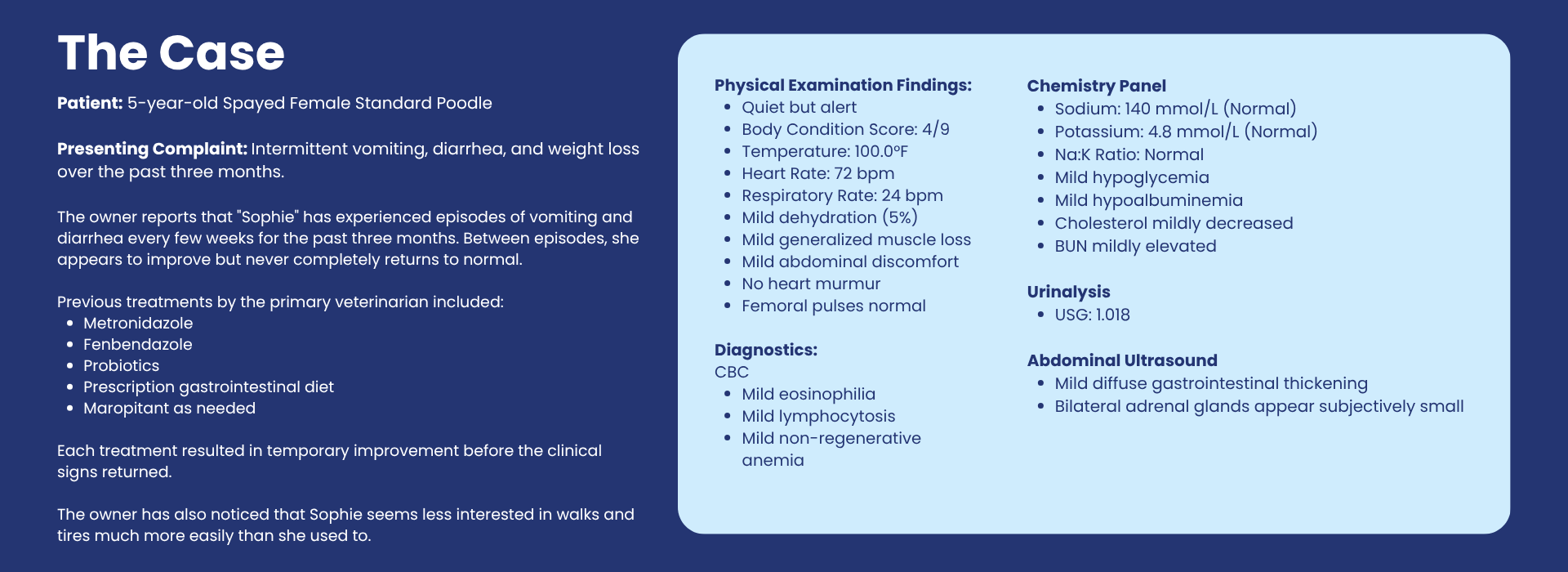
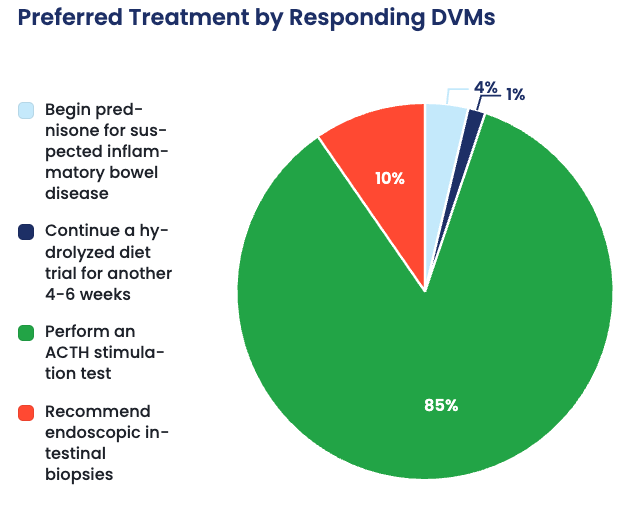
This week’s case showed strong alignment between DVMs and our specialists, with 83% selecting an ACTH stimulation test as the next step. Despite normal electrolytes, Sophie’s chronic GI signs, eosinophilia, mild hypoglycemia, poor urine concentration, and small adrenal glands raised concern for atypical hypoadrenocorticism, making Addison’s disease important to rule out before pursuing steroids or more invasive GI diagnostics.
How a General Practitioner Might Approach This Case
Dogs with chronic intermittent gastrointestinal disease are common in general practice.
Repeated vomiting.
Diarrhea.
Weight loss.
Poor body condition.
Many of these patients ultimately receive diagnoses such as:
- Chronic enteropathy
- Food-responsive disease
- Inflammatory bowel disease
- Pancreatitis
Because Sophie has already shown temporary improvement with symptomatic therapy, it would be easy to continue pursuing gastrointestinal disease as the primary diagnosis.
However, specialists often notice several findings that don’t quite fit.
How Specialists Typically View This Case
From an internal medicine perspective, the most appropriate recommendation is:
Perform an ACTH Stimulation Test
Although Addison’s disease is classically associated with hyponatremia and hyperkalemia, approximately 10–20% of affected dogs present with normal electrolytes.
These patients have atypical hypoadrenocorticism, making the diagnosis considerably more challenging.
Without electrolyte abnormalities, many dogs are treated for gastrointestinal disease for months before the underlying endocrine disorder is recognized.
The Clues Aren’t the Electrolytes
One of the biggest misconceptions surrounding Addison’s disease is that every patient develops classic sodium and potassium abnormalities. Specialists know that isn’t always true. Instead, they focus on the entire patient. Sophie demonstrates several subtle findings that, when viewed together, become highly suspicious.
These include:
- Chronic waxing-and-waning gastrointestinal signs
- Weight loss
- Mild hypoglycemia
- Low cholesterol
- Poor urine concentrating ability despite dehydration
- Mild eosinophilia
- Mild lymphocytosis
- Bilaterally small adrenal glands on ultrasound
Individually, none of these abnormalities confirms Addison’s disease. Together, they paint a much different picture.
Why the ACTH Stimulation Test Comes First
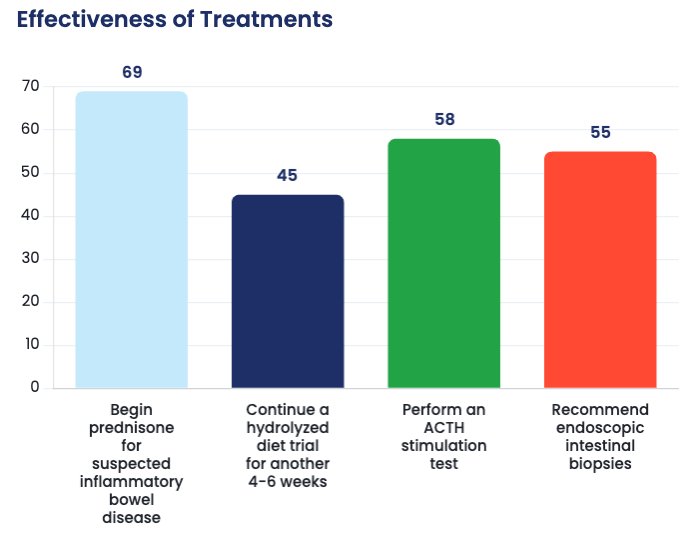
The ACTH stimulation test remains the gold standard for confirming hypoadrenocorticism. Unlike empirical treatment or invasive diagnostics, it directly evaluates adrenal reserve. Most importantly, it provides a definitive diagnosis before glucocorticoid therapy alters test results. Early diagnosis allows clinicians to begin lifelong hormone replacement while avoiding months of unnecessary gastrointestinal investigations.
Why Not Begin Prednisone?
Prednisone may temporarily improve clinical signs. Unfortunately, it can also interfere with diagnostic testing. Once glucocorticoids are administered, confirming Addison’s disease becomes significantly more difficult. Whenever possible, specialists recommend obtaining an ACTH stimulation test before initiating treatment in clinically stable patients.
Why Not Perform Endoscopy?
Endoscopic biopsies are entirely appropriate for dogs with suspected chronic enteropathy.
The problem is timing.
If the underlying disease is endocrine rather than gastrointestinal, invasive diagnostics expose the patient to anesthesia, expense, and procedural risk without identifying the true cause. Specialists prefer ruling out Addison’s disease before pursuing intestinal biopsies.
Why Not Continue the Diet Trial?
Diet-responsive enteropathy is common. However, Sophie has already failed multiple empirical therapies over several months. Her continued decline despite treatment suggests another underlying disease process. Continuing dietary management alone delays definitive diagnosis.
Practical Application in General Practice
When evaluating dogs with chronic gastrointestinal disease, specialists recommend asking four important questions.
Could this be Addison’s disease?
Even when electrolytes are normal.
Does the CBC show a stress leukogram?
The absence of a stress leukogram—or the presence of eosinophilia and lymphocytosis—should raise suspicion.
Are the adrenal glands unusually small?
Although not diagnostic, this finding supports further endocrine testing.
Has the patient failed appropriate empirical therapy?
Repeated relapses despite treatment should prompt clinicians to reconsider the diagnosis.
Specialist Takeaway
Not every dog with Addison’s disease arrives in shock. Some spend months being treated for gastrointestinal disease because their electrolyte values appear completely normal. This form of atypical hypoadrenocorticism remains one of the most frequently overlooked endocrine disorders in small animal practice.
For this reason, our internal medicine specialist recommends:
Perform an ACTH Stimulation Test
The broader lesson extends well beyond Addison’s disease. When patients fail to respond to appropriate therapy, don’t simply change treatments—revisit the diagnosis. Sometimes the answer isn’t a more aggressive treatment plan. It’s recognizing that the original diagnosis was never the right one.
References (MLA)
Lathan, Patty, and David C. Scott-Moncrieff. “Canine Hypoadrenocorticism: Pathogenesis, Diagnosis, and Treatment.” Veterinary Clinics of North America: Small Animal Practice, vol. 48, no. 4, 2018, pp. 721–736.
Thompson, Amanda L., et al. “Clinical Features of Dogs with Atypical Hypoadrenocorticism.” Journal of Veterinary Internal Medicine, vol. 21, no. 4, 2007, pp. 609–614.
Scott-Moncrieff, J. Catharine. “Hypoadrenocorticism.” Textbook of Veterinary Internal Medicine, 9th ed., Elsevier, 2024.
Feldman, Edward C., Richard W. Nelson, Claudia Reusch, and J. Catharine Scott-Moncrieff. Canine and Feline Endocrinology. 5th ed., Elsevier, 2020.