
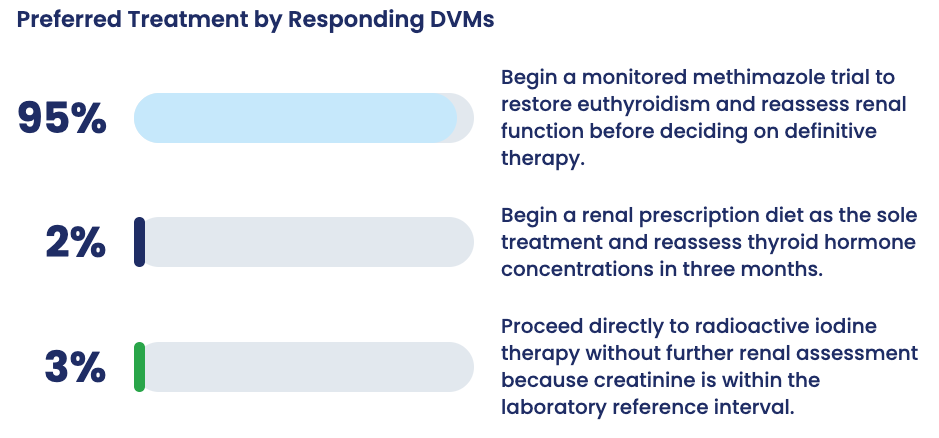
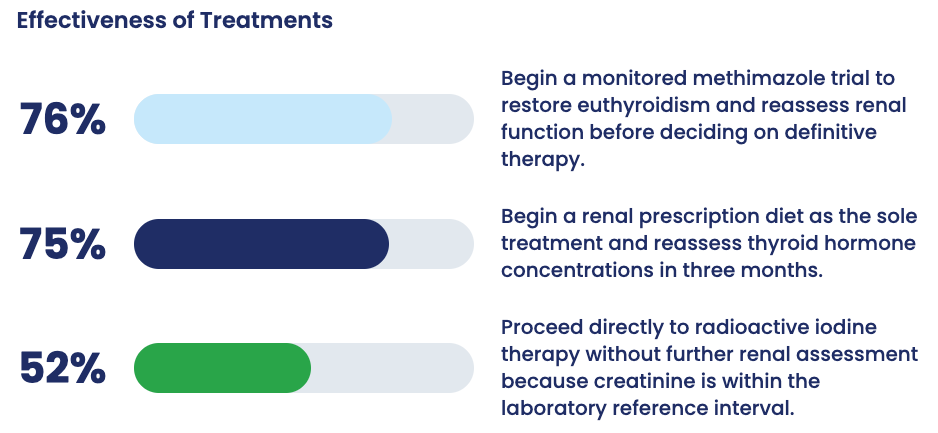
When managing feline hyperthyroidism, how much should renal function influence treatment decisions? In this week’s Clinical Outcomes survey, 95% of responding DVMs favored a monitored methimazole trial to restore euthyroidism and reassess kidney function before pursuing definitive therapy. Respondents reported a 76% effectiveness rate for this approach, reinforcing the importance of evaluating how thyroid treatment may affect underlying renal function. Let’s explore the clinical considerations behind these results and how they align with current veterinary literature.
When Treating One Condition Reveals Another
In veterinary medicine, treating one disease can sometimes reveal another that was previously difficult to detect. Feline hyperthyroidism is a particularly important example, as the physiologic effects of excess thyroid hormone can influence how kidney function is assessed and interpreted.
Hyperthyroidism is one of the most common endocrine disorders in older cats. While treatment is essential to restoring metabolic stability and improving quality of life, managing the disease becomes more complicated when concurrent chronic kidney disease (CKD) is suspected.
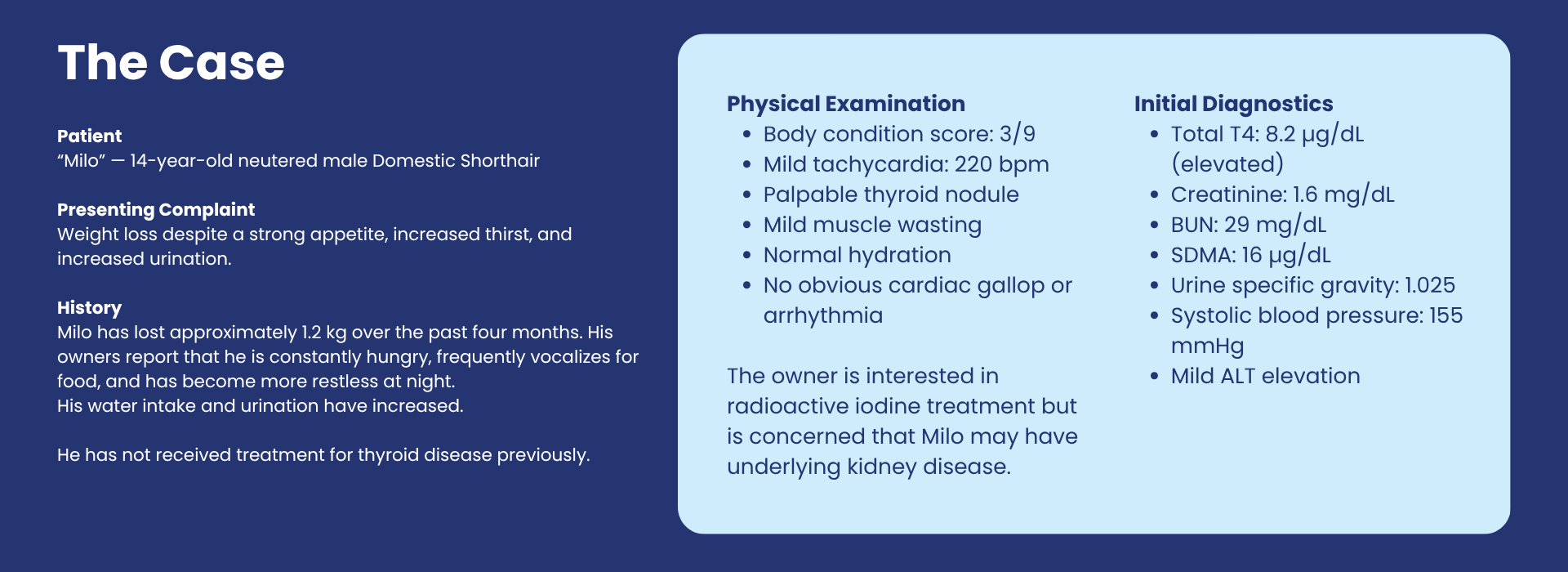
This week’s Clinical Outcomes case follows Milo, a 14-year-old neutered male Domestic Shorthair presenting with progressive weight loss despite a strong appetite, increased thirst, increased urination, and restlessness.
His examination revealed a body condition score of 3/9, mild muscle wasting, tachycardia, and a palpable thyroid nodule. Laboratory testing identified an elevated total T4 of 8.2 µg/dL, creatinine of 1.6 mg/dL, SDMA of 16 µg/dL, and urine specific gravity of 1.025.
Although Milo’s creatinine was within the laboratory reference interval, his age, reduced muscle mass, urine concentration, and mildly elevated SDMA raised concern for possible underlying renal dysfunction.
His owners were interested in radioactive iodine therapy but wanted to understand whether definitive treatment could negatively affect his kidneys.
This introduces a common clinical challenge: How should veterinarians treat hyperthyroidism when kidney disease may be present but is not yet fully characterized?
Understanding the Relationship Between Hyperthyroidism and Kidney Function
Thyroid hormones influence multiple organ systems, including the cardiovascular and renal systems.
In hyperthyroid cats, increased cardiac output, renal blood flow, and glomerular filtration rate (GFR) can alter the interpretation of kidney function tests.
This creates an important diagnostic challenge.
A hyperthyroid cat may have underlying kidney disease that is not readily apparent from serum creatinine concentrations alone. Increased GFR can contribute to lower creatinine concentrations, while muscle wasting can further reduce creatinine production.
Once hyperthyroidism is treated and the patient returns toward a euthyroid state, GFR may decrease. Previously unrecognized kidney dysfunction can then become apparent through rising creatinine concentrations or other changes in renal parameters.
Importantly, this does not necessarily mean that treating hyperthyroidism has directly damaged the kidneys. In many patients, treatment reveals renal dysfunction that was previously masked by the effects of excess thyroid hormone.
The distinction is essential when discussing treatment options and prognosis with pet owners.
The General Practitioner’s Perspective: Balancing Thyroid Treatment and Renal Assessment
For general practitioners, Milo’s presentation is relatively familiar. Weight loss despite polyphagia, increased activity, tachycardia, and a palpable thyroid nodule are classic findings associated with feline hyperthyroidism.
His elevated total T4 supports the diagnosis.
The more complicated decision involves how to interpret his renal values and determine the most appropriate treatment strategy.
Why might Milo’s kidney values be misleading?
Milo’s creatinine is 1.6 mg/dL, but this value should not be interpreted in isolation.
His mild muscle wasting may reduce creatinine production, potentially making kidney function appear better than it is.
Additionally, his urine specific gravity of 1.025 is not maximally concentrated, and his SDMA of 16 µg/dL warrants consideration alongside the rest of the clinical picture.
Neither finding independently establishes CKD. However, together with Milo’s age and clinical history, they justify closer evaluation.
A GP would reasonably consider repeat renal testing, urinalysis, urine protein assessment when indicated, blood pressure monitoring, and evaluation for other causes of altered urine concentration.
It is also important to recognize that CKD diagnosis and IRIS staging should not be based on a single creatinine or SDMA measurement, particularly while thyroid function remains uncontrolled.
What role does a methimazole trial play?
One approach frequently considered in cases like Milo’s is a monitored trial of methimazole.
Methimazole reduces thyroid hormone synthesis and allows clinicians to assess how renal parameters change as the patient approaches euthyroidism.
Unlike radioactive iodine treatment, methimazole therapy is adjustable and reversible, making it useful when there is uncertainty about how a patient will tolerate normalization of thyroid hormone concentrations.
During treatment, a GP would monitor:
- Total T4 to assess thyroid control.
- Creatinine, BUN, and SDMA to evaluate changes in renal markers.
- Urinalysis and urine concentrating ability.
- Body weight, appetite, hydration, and clinical signs.
- CBC and liver parameters to identify potential methimazole-associated adverse effects.
- Blood pressure, particularly if hypertension is suspected or develops.
The objective is not to deliberately maintain hyperthyroidism to preserve a higher GFR. Instead, it is to determine how the patient responds to appropriate thyroid control and whether additional renal management is necessary.
Does every cat need a methimazole trial before radioactive iodine?
No.
Although a monitored methimazole trial can be useful, particularly when underlying renal disease is suspected, it is not an absolute prerequisite for radioactive iodine therapy.
For some patients, radioactive iodine is an appropriate first-line treatment because it offers the potential for a permanent cure without the need for lifelong antithyroid medication.
The decision should account for renal findings, overall clinical stability, concurrent diseases, owner preferences, access to treatment, and the ability to provide follow-up monitoring.
For Milo, a monitored methimazole trial is a reasonable approach to characterize renal function before committing to definitive treatment, but it is not the only medically defensible pathway.
The Internal Medicine Specialist’s Perspective: Treating the Thyroid Without Overlooking the Kidneys
For a veterinary internal medicine specialist, Milo’s case involves two related but distinct questions: how to achieve appropriate thyroid control and how to determine whether clinically significant kidney disease is present.
The goal is not to choose between treating hyperthyroidism and protecting renal function. It is to manage both conditions appropriately while avoiding the complications of uncontrolled thyroid disease or excessive thyroid suppression.
The American Association of Feline Practitioners (AAFP) guidelines recommend treating hyperthyroidism even when CKD is present, with careful monitoring to achieve euthyroidism and avoid iatrogenic hypothyroidism.
- Establish a more complete picture of renal function
Milo’s creatinine, SDMA, and urine specific gravity raise concern for possible renal dysfunction, but they do not establish its severity or confirm a diagnosis of CKD.
An internist would consider additional evaluation, potentially including urine protein-to-creatinine ratio, repeat blood pressure measurements, renal imaging when indicated, and serial renal function testing.
The timing of these assessments matters. Renal parameters obtained during uncontrolled hyperthyroidism may differ from those measured after thyroid function normalizes.
A specialist would also consider whether Milo’s weight loss and muscle wasting are influencing the interpretation of his creatinine concentration.
- Restore euthyroidism while avoiding hypothyroidism
One of the most important considerations in treating hyperthyroid cats with suspected kidney disease is avoiding excessive thyroid suppression.
Research and consensus guidelines indicate that iatrogenic hypothyroidism can be associated with worsening renal function and reduced survival in affected cats.
An internist would therefore monitor thyroid hormone concentrations alongside renal parameters and consider TSH testing when hypothyroidism is suspected.
If Milo develops azotemia after treatment, the response should not automatically be to discontinue thyroid therapy or intentionally maintain mild hyperthyroidism.
Instead, the clinician should assess thyroid control, hydration, renal function, blood pressure, and other evidence of kidney disease before modifying treatment.
The objective is a euthyroid patient with appropriately managed renal disease, not a hyperthyroid patient whose creatinine appears artificially reassuring.
- Determine whether radioactive iodine remains appropriate
Radioactive iodine (I-131) is widely regarded as a preferred definitive treatment for many cats with hyperthyroidism because it can eliminate hyperfunctioning thyroid tissue without requiring lifelong antithyroid medication.
The AAFP guidelines report successful treatment after a single administration in more than 95% of cats in many published studies.
However, Milo’s suspected renal dysfunction introduces additional considerations.
A specialist would evaluate whether his renal function remains clinically acceptable after restoration of euthyroidism, whether concurrent conditions are adequately controlled, and whether he is an appropriate candidate for radioactive iodine treatment.
A successful methimazole trial can provide useful information, but it does not guarantee that renal function will remain unchanged after definitive therapy.
If radioactive iodine is pursued, follow-up monitoring remains essential to detect persistent hyperthyroidism, hypothyroidism, or newly apparent renal dysfunction.
What Does the Research Tell Us?
Published veterinary guidelines provide several important principles for managing cats like Milo.
| Clinical consideration | Evidence-supported interpretation |
| Normal creatinine before treatment | Does not exclude underlying CKD in a hyperthyroid cat |
| Development of azotemia after treatment | May reveal previously masked renal dysfunction |
| Methimazole trial | Can help evaluate renal response before irreversible treatment |
| Concurrent hyperthyroidism and CKD | Both conditions should be managed rather than leaving hyperthyroidism untreated |
| Iatrogenic hypothyroidism | Should be avoided because of its potential adverse effects on renal function |
| Radioactive iodine | Remains an important definitive treatment option in appropriately selected patients |
These principles are consistent with the AAFP management guidelines, which emphasize treatment of hyperthyroidism regardless of concurrent disease while adjusting monitoring and management to the patient’s renal status.
Why the Other Treatment Approaches May Be Insufficient
Milo’s case includes several treatment options, each representing a different way to interpret his laboratory findings.
Proceed directly to radioactive iodine without further renal assessment: Radioactive iodine may ultimately be appropriate, but a creatinine concentration within the reference interval does not eliminate concern for underlying kidney disease. A more complete baseline assessment is warranted.
Delay hyperthyroidism treatment until creatinine increases: This approach risks allowing the systemic effects of excess thyroid hormone to continue. Untreated hyperthyroidism can contribute to cardiovascular changes, hypertension, progressive weight loss, and other complications. The presence or possibility of CKD is not, by itself, a reason to withhold treatment.
Begin a renal prescription diet as the sole treatment: A renal diet may eventually be appropriate if CKD is established, but it does not treat the underlying hyperthyroidism. Nutritional recommendations should also account for Milo’s weight loss, muscle wasting, and overall caloric needs.
Begin a monitored methimazole trial: This is a reasonable approach for Milo because it allows thyroid function to be controlled while clinicians reassess renal parameters before committing to irreversible treatment.
The distinction is not that every hyperthyroid cat requires methimazole before radioactive iodine. Rather, Milo has specific findings that make additional renal assessment particularly valuable.
Bridging General Practice and Specialty Care
Feline hyperthyroidism is frequently diagnosed and managed successfully in general practice. Veterinarians routinely identify the clinical signs, confirm thyroid hormone abnormalities, initiate treatment, and monitor patient response.
The challenge becomes more complex when concurrent diseases affect the interpretation of diagnostic results or influence treatment decisions.
For Milo, a GP can initiate a monitored methimazole trial and evaluate his renal response. Referral to an internal medicine specialist may be beneficial if kidney function deteriorates, thyroid regulation becomes difficult, or additional diagnostic evaluation is needed.
A specialist can also help determine whether definitive treatment remains appropriate and how to manage the patient if both hyperthyroidism and CKD are confirmed.
Ultimately, both approaches should emphasize individualized treatment, appropriate monitoring, and clear communication with the owner.
An important part of that conversation is explaining that a rise in creatinine following successful thyroid treatment does not necessarily mean the treatment harmed the kidneys. It may instead reveal renal disease that was previously difficult to identify.
Clinical Takeaway: Normal Kidney Values Don’t Always Mean Normal Kidney Function
Milo’s case illustrates how one disease can influence the diagnostic interpretation of another.
In hyperthyroid cats, increased glomerular filtration and reduced muscle mass may mask underlying renal dysfunction. As thyroid hormone concentrations normalize, kidney disease that was previously unrecognized can become more apparent.
For general practitioners, the key is recognizing when renal findings warrant closer evaluation and selecting a treatment strategy that allows appropriate monitoring.
For specialists, the focus expands to characterizing renal disease, avoiding iatrogenic hypothyroidism, and determining the safest long-term approach to thyroid control.
The central lesson is that treating hyperthyroidism should not be delayed simply because kidney disease is suspected. Instead, clinicians should recognize how the two conditions interact and use that information to guide treatment and monitoring.
References
- Carney, Hazel C., et al. “2016 AAFP Guidelines for the Management of Feline Hyperthyroidism.” Journal of Feline Medicine and Surgery, vol. 18, no. 5, 2016, pp. 400–416. https://doi.org/10.1177/1098612X16643252.
- International Renal Interest Society. IRIS Staging of CKD. IRIS, www.iris-kidney.com. Guidance on the diagnosis, staging, and monitoring of chronic kidney disease in cats.
- Peterson, Mark E. “Hyperthyroidism in Cats: What’s Causing This Epidemic of Thyroid Disease and Can We Prevent It?” Journal of Feline Medicine and Surgery, vol. 14, no. 11, 2012, pp. 804–818. https://doi.org/10.1177/1098612X12464462.
- van Hoek, Ingrid, and Sylvie Daminet. “Interactions between Thyroid and Kidney Function in Pathological Conditions of These Organ Systems: A Review.” General and Comparative Endocrinology, vol. 160, no. 3, 2009, pp. 205–215. https://doi.org/10.1016/j.ygcen.2008.12.008.
Disclaimer: The mentioned insights reflect specialist-level perspectives informed by published veterinary research, clinical guidelines, and established standards of care. They are intended to provide additional clinical context and may not represent the direct opinion of an individual veterinary specialist.