

When Therapeutic Drug Levels Aren’t Enough
Clinical Takeaway: Treat the seizure emergency first, even when antiseizure drug levels are therapeutic.
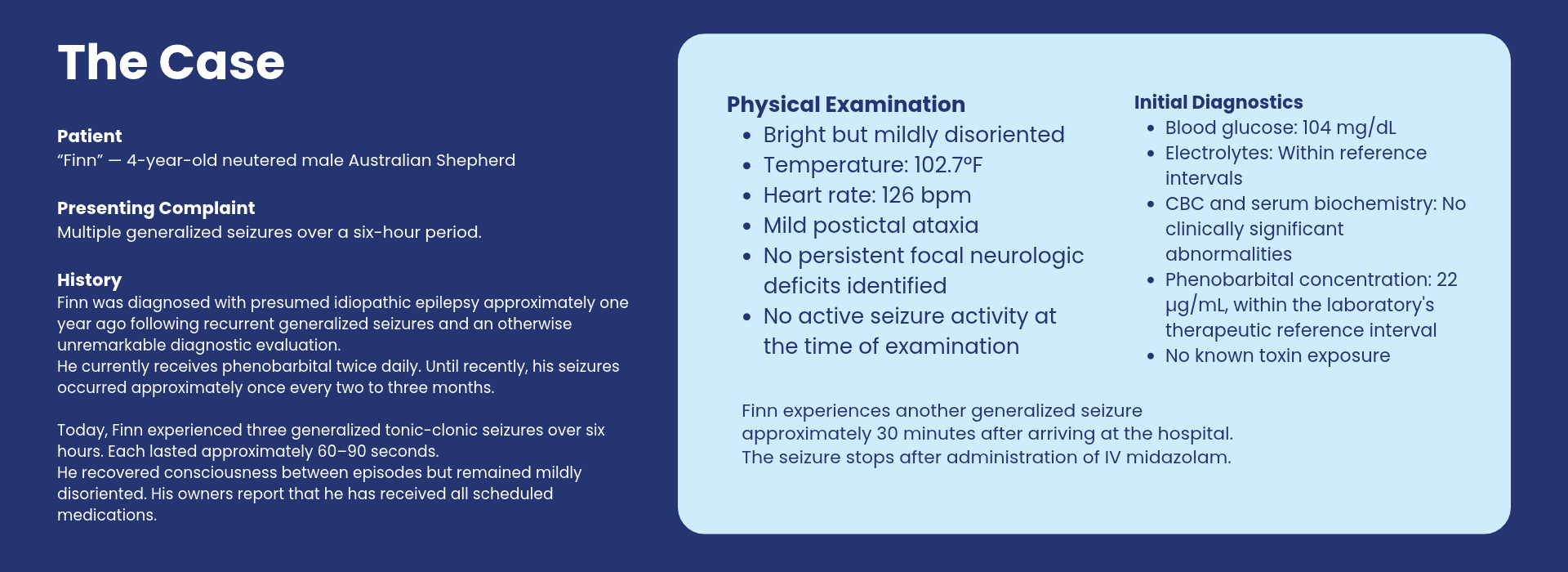
Finn, a 4-year-old Australian Shepherd with presumed idiopathic epilepsy, experienced four generalized seizures within several hours despite receiving phenobarbital as prescribed. His phenobarbital concentration was 22 µg/mL, within the therapeutic reference range.
The key distinction: A therapeutic drug concentration does not guarantee adequate seizure control. Finn is experiencing cluster seizures, a neurologic emergency requiring immediate intervention.
The GP Approach: Stop the Cluster, Not Just the Seizure
Although IV midazolam successfully stopped Finn’s most recent seizure, the risk of recurrence remains high.
Recommended next steps:
- Initiate additional antiseizure treatment. Consider a levetiracetam loading or pulse protocol to reduce the risk of further seizures.
- Continue hospitalization and monitoring. Observe for recurrent activity and escalate treatment if seizures persist.
- Assess contributing factors. Confirm medication adherence, review dosing and recent seizure history, and evaluate for metabolic or other potential triggers.
- Reassess maintenance therapy after stabilization. Increasing phenobarbital may be appropriate, but adjusting routine oral dosing alone is insufficient for managing the immediate cluster episode.
The priority is preventing additional seizures and progression to status epilepticus, not simply responding to each seizure as it occurs.
The Neurologist’s Perspective: Prevent the Next Emergency
Once Finn is stabilized, the focus shifts to determining why his current treatment is no longer adequately controlling his seizures.
A neurologist would consider:
- Optimizing long-term medication: Evaluate phenobarbital dosing, tolerability, and whether an additional maintenance antiseizure medication is warranted.
- Reassessing the diagnosis: Consider MRI or additional diagnostics if neurologic abnormalities or other concerning findings suggest an underlying structural or metabolic cause.
- Establishing a home rescue plan: Provide individualized instructions for rescue medication, such as intranasal midazolam, and when emergency evaluation is necessary.
Advanced diagnostics are not automatically necessary for every breakthrough seizure. Treatment decisions should reflect the patient’s clinical presentation and response.
Why the Other Approaches Fall Short
- Continue phenobarbital unchanged: A therapeutic level does not address inadequate seizure control.
- Increase phenobarbital and discharge: Maintenance adjustments may be needed, but they do not replace immediate cluster-seizure management.
- Start corticosteroids: There is insufficient evidence of inflammatory brain disease to justify empiric treatment.
The Bottom Line
The correct immediate approach is additional antiseizure treatment with continued hospitalization and monitoring.
Finn’s case reinforces three clinical principles:
- Cluster seizures are an emergency, even when individual seizures stop.
- Therapeutic serum concentrations do not equal therapeutic seizure control.
- Stabilize first, then optimize long-term management to prevent recurrence.
Want to know more, read more detailed information below…
———————————————————————————-
Cluster Seizures in Dogs: When Therapeutic Drug Levels Aren’t Enough
In veterinary medicine, managing epilepsy involves more than prescribing antiseizure medication and monitoring serum drug concentrations. While therapeutic drug monitoring is an important component of long-term management, a concentration within the recommended reference interval does not always mean a patient’s seizures are adequately controlled.
Cluster seizures present a particularly important challenge. Dogs experiencing multiple seizures within a short period face an increased risk of additional episodes, prolonged seizure activity, and potentially life-threatening complications.
This week’s Clinical Outcomes case follows Finn, a 4-year-old neutered male Australian Shepherd with a history of presumed idiopathic epilepsy.
Finn has been receiving phenobarbital twice daily for approximately one year. Until recently, his seizures occurred once every two to three months. However, he experienced three generalized tonic-clonic seizures over six hours, each lasting approximately 60–90 seconds. Despite receiving his scheduled medications, Finn experienced another seizure shortly after arriving at the veterinary hospital. His blood glucose and electrolytes were within reference intervals, and his phenobarbital concentration measured 22 µg/mL, within the laboratory’s therapeutic reference interval. The most recent seizure stopped following administration of intravenous midazolam.
These findings introduce an important clinical question: When a dog experiences cluster seizures despite a therapeutic phenobarbital concentration, should treatment focus on adjusting maintenance medication or immediately controlling the current seizure emergency?
Understanding Cluster Seizures in Dogs
Cluster seizures are generally defined as two or more epileptic seizures occurring within a 24-hour period, with recovery of consciousness between episodes. They differ from status epilepticus, which involves continuous seizure activity lasting at least five minutes or recurrent seizures without complete recovery of consciousness between episodes.
Both conditions are considered neurologic emergencies, although their immediate management and progression may differ. Cluster seizures are particularly concerning because individual seizures may appear brief and self-limiting while the overall pattern indicates increasing seizure activity. A dog may recover after each episode but remain at risk for additional seizures, hyperthermia, metabolic disturbances, injury, and progression to status epilepticus.
For Finn, the significance is not simply that he experienced another seizure despite treatment. It is that his seizure pattern has changed substantially. Previously, his seizures occurred every few months. He has now experienced four generalized seizures within several hours. This represents an acute deterioration in seizure control that requires prompt intervention.
The General Practitioner’s Perspective: Recognizing When Breakthrough Seizures Become an Emergency
For general practitioners, dogs with established epilepsy are commonly managed through maintenance antiseizure medication, periodic bloodwork, therapeutic drug monitoring, and adjustments based on seizure frequency and adverse effects.
An isolated breakthrough seizure does not always require emergency hospitalization, particularly when the patient recovers normally and has a previously established management plan.
Cluster seizures, however, require a different level of urgency.
What should the initial assessment include?
When Finn arrives at the hospital, the GP’s first priorities are to assess his stability, determine whether seizure activity is ongoing, and identify potentially reversible contributors.
A focused evaluation should include:
- Seizure history: Frequency, duration, recovery between episodes, and changes from the patient’s established pattern.
- Medication history: Current drugs, doses, administration schedule, missed doses, recent medication changes, and potential interactions.
- Physical and neurologic examination: Mentation, temperature, cardiovascular and respiratory status, and persistent neurologic abnormalities.
- Laboratory assessment: Blood glucose, electrolytes, and other testing indicated by the clinical presentation.
- Therapeutic drug monitoring: Serum phenobarbital concentration, interpreted in relation to dose timing, seizure control, and adverse effects.
In Finn’s case, the normal glucose and electrolyte results make certain reactive causes of seizures less likely, while his history supports an exacerbation of previously diagnosed epilepsy. However, the absence of major abnormalities on routine bloodwork does not eliminate the possibility of additional contributing factors.
What does Finn’s phenobarbital concentration tell us?
Finn’s phenobarbital concentration is 22 µg/mL, within the commonly used therapeutic reference range of approximately 15–35 µg/mL. This result provides useful information about systemic drug exposure, but it does not establish that the current treatment regimen is sufficient.
Therapeutic ranges describe concentrations associated with acceptable seizure control and tolerability in many patients. Individual dogs may require different concentrations to achieve adequate control, and some continue experiencing seizures despite concentrations within the reference interval.
The relationship between serum concentration and clinical response is therefore important. A therapeutic phenobarbital concentration is not the same as therapeutic seizure control. For Finn, the occurrence of cluster seizures despite a concentration within the reference interval indicates that his current treatment strategy requires reassessment.
How should a GP manage the immediate situation?
Finn has already received IV midazolam, which successfully terminated his most recent seizure. However, stopping one seizure does not necessarily eliminate the risk of another. The 2024 American College of Veterinary Internal Medicine (ACVIM) consensus statement on status epilepticus and cluster seizures emphasizes prompt intervention using an individualized, staged treatment approach.
For a patient like Finn, this may include additional antiseizure medication, such as a levetiracetam loading protocol, along with continued monitoring and hospitalization. The immediate goal is to prevent further seizures and reduce the likelihood of progression to status epilepticus. Increasing his maintenance phenobarbital dose may eventually be appropriate, but an adjustment to routine oral dosing alone would not provide sufficiently rapid protection during an active cluster-seizure episode.
Similarly, discharge immediately after one seizure has stopped may be inappropriate when multiple seizures have occurred within a short period. For the general practitioner, recognizing the change in seizure pattern and initiating timely emergency treatment are essential components of care.
The Veterinary Neurologist’s Perspective: Controlling the Emergency Before Reassessing Long-Term Treatment
For a veterinary neurologist, Finn’s presentation raises two related but distinct concerns: controlling his current cluster seizures and determining why his previously established antiseizure regimen is no longer providing adequate control.
Although his phenobarbital concentration is within the laboratory’s therapeutic reference interval, this finding does not eliminate the need for additional treatment.
The 2024 ACVIM consensus statement on status epilepticus and cluster seizures recommends a rapid, staged approach that combines short-acting medications for immediate seizure termination with longer-acting medications to reduce recurrence.
- Prevent additional seizures
Finn’s response to IV midazolam is encouraging, but the immediate risk of another seizure remains.
A neurologist would consider additional antiseizure treatment, particularly levetiracetam, to provide longer-lasting protection after the initial benzodiazepine effect diminishes.
The ACVIM consensus statement supports IV levetiracetam pulse treatment in hospitalized dogs experiencing cluster seizures. If seizures recur despite initial treatment, additional benzodiazepine therapy, potentially including a midazolam continuous-rate infusion, may be indicated.
For Finn, adding levetiracetam while continuing hospitalization would be consistent with this staged treatment approach.
The objective is to interrupt the cluster pattern before seizures become more frequent, prolonged, or resistant to treatment.
- Reassess the existing phenobarbital regimen
Once Finn’s immediate seizure activity is controlled, attention can shift toward optimizing his maintenance medication.
A phenobarbital concentration of 22 µg/mL is within commonly used therapeutic ranges, but it is not necessarily the optimal concentration for this individual patient.
The International Veterinary Epilepsy Task Force (IVETF) consensus proposal emphasizes that antiseizure treatment should be guided by both serum drug concentrations and clinical response.
In dogs with inadequate seizure control, phenobarbital dosage adjustments may be considered when serum concentrations are below the upper end of the recommended range, provided the patient tolerates treatment and monitoring does not identify contraindications.
For Finn, a neurologist would evaluate his current dose, serum concentration, medication adherence, and potential adverse effects before deciding whether to increase phenobarbital or introduce an additional maintenance antiseizure medication.
The presence of cluster seizures may justify a more aggressive long-term management strategy even if Finn’s previous seizure frequency was considered acceptable.
- Determine whether additional diagnostics are warranted
Finn’s history is consistent with presumed idiopathic epilepsy, but a change in seizure frequency should prompt reassessment.
A specialist would review his original diagnostic evaluation, including whether advanced imaging and cerebrospinal fluid analysis were previously performed.
Additional investigation may be considered if Finn develops persistent neurologic deficits, an unusual seizure pattern, systemic abnormalities, or other findings suggesting an underlying structural or metabolic disorder.
Magnetic resonance imaging and cerebrospinal fluid analysis may be appropriate in selected patients, but they are not automatically required for every dog experiencing breakthrough seizures.
The immediate priority remains stabilization and seizure control. Further diagnostics can then be individualized based on the patient’s history and clinical findings.
- Develop a home rescue plan
For dogs with a history of cluster seizures, a neurologist would also consider establishing a clear emergency treatment plan for the owner.
This may include prescribed intranasal midazolam or rectal diazepam for appropriate seizure emergencies, along with an individualized levetiracetam pulse protocol.
Owners should receive specific instructions regarding when to administer medication, when repeat treatment is appropriate, and when immediate emergency evaluation is necessary.
The 2024 ACVIM consensus statement supports the use of rescue medications and levetiracetam pulse treatment as components of out-of-hospital cluster-seizure management in appropriately selected patients.
These plans are particularly valuable because they allow treatment to begin earlier when future cluster episodes occur.
What Does the Research Tell Us?
The published literature provides several important principles for managing dogs with breakthrough and cluster seizures.
| Clinical consideration | Evidence-supported interpretation |
| Two or more seizures within 24 hours | Meets the definition of cluster seizures when consciousness returns between episodes |
| Phenobarbital within the therapeutic range | Does not guarantee adequate seizure control |
| IV midazolam terminates an active seizure | Does not eliminate the risk of additional seizures |
| Levetiracetam pulse treatment | Recommended as a longer-acting intervention for cluster-seizure management |
| Increasing maintenance phenobarbital | May be appropriate after assessing serum concentration, response, and tolerability |
| Recurrent cluster seizures | Warrant reassessment of the long-term epilepsy management plan |
These principles are supported by the ACVIM consensus statement and the IVETF recommendations for medical treatment of canine epilepsy.
Why the Other Treatment Approaches May Be Insufficient
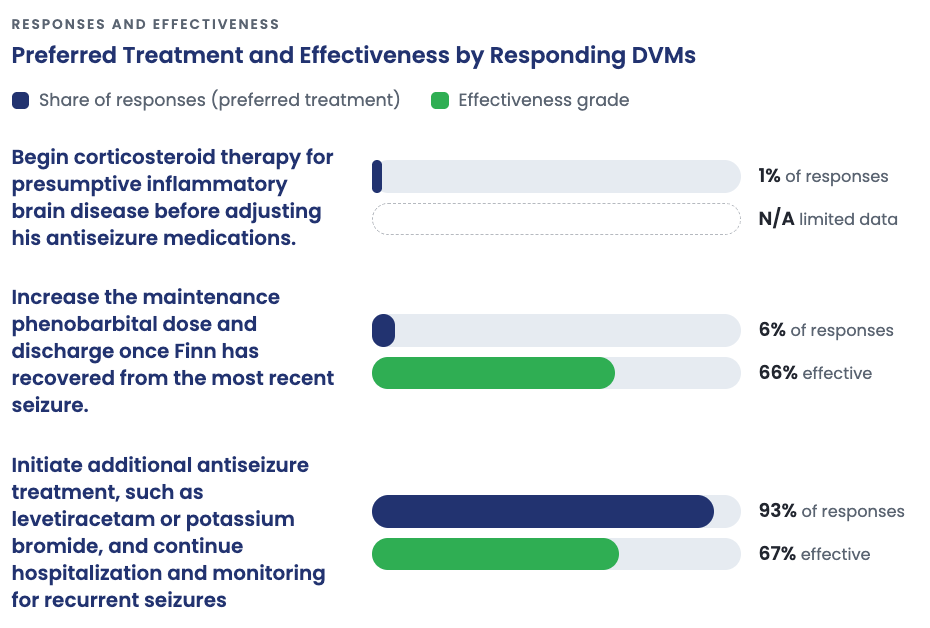
Finn’s case presents four treatment approaches that reflect decisions veterinarians may encounter when managing breakthrough seizures.
- Continue phenobarbital unchanged because the serum concentration is therapeutic.
Although Finn’s phenobarbital concentration is within the reference interval, he is experiencing clinically significant breakthrough seizures. Continuing his regimen without addressing the current cluster pattern would not adequately manage the immediate emergency.
- Initiate additional antiseizure treatment and continue hospitalization.
This approach addresses Finn’s immediate risk of recurrent seizures. Levetiracetam loading or pulse treatment is supported by the ACVIM consensus recommendations, and hospitalization allows continued observation and escalation of treatment if necessary.
- Increase maintenance phenobarbital and discharge after recovery.
Increasing phenobarbital may be a reasonable component of Finn’s long-term treatment plan. However, an adjustment to routine maintenance dosing alone does not provide the same immediate protection as an appropriately administered loading or additional antiseizure protocol. Discharge after a single seizure-free interval may also be premature in a patient experiencing repeated seizures.
- Begin corticosteroids for presumptive inflammatory brain disease.
Inflammatory central nervous system disease remains a possible cause of seizures in some dogs, but Finn’s current findings do not establish that diagnosis. Empirical corticosteroids are not a substitute for emergency antiseizure treatment and may complicate subsequent diagnostic evaluation.
For Finn, the most appropriate immediate management is to address the ongoing cluster-seizure emergency while planning a reassessment of his long-term epilepsy treatment.
Bridging General Practice and Specialty Care
Cluster seizures demonstrate how general practitioners and veterinary neurologists contribute to different stages of epilepsy management. The GP is often responsible for recognizing the change in seizure pattern, stabilizing the patient, administering emergency antiseizure medication, and determining whether hospitalization or referral is necessary.
These early decisions are particularly important because repeated seizures can become increasingly difficult to control. The neurologist can build on this initial stabilization by evaluating treatment response, optimizing maintenance medications, investigating potential contributing conditions, and developing an individualized rescue plan.
However, many dogs with epilepsy can be managed successfully in general practice with appropriate monitoring and access to consultation when needed. The central objective is not simply to eliminate every breakthrough seizure. It is to reduce seizure frequency and severity, prevent emergencies, minimize medication adverse effects, and maintain the patient’s quality of life.
For Finn, this means recognizing that his current treatment plan is no longer adequately controlling his seizures, even though his serum phenobarbital concentration falls within the therapeutic reference interval.
Clinical Takeaway: Treat the Patient, Not Just the Drug Level
Finn’s case illustrates an important distinction in veterinary neurology: laboratory evidence of therapeutic drug exposure does not always translate into adequate clinical seizure control.
A phenobarbital concentration within the recommended range provides useful information, but it must be interpreted alongside seizure frequency, severity, duration, and the patient’s response to treatment.
For general practitioners, the priority is recognizing cluster seizures as an emergency and initiating appropriate treatment to prevent additional episodes.
For specialists, the focus expands to optimizing long-term antiseizure therapy, evaluating possible causes of worsening seizure control, and establishing a plan to reduce future emergencies.
The central lesson is that seizure management should be guided by the patient’s clinical response, not serum drug concentrations alone. When seizure patterns change, treatment strategies must evolve accordingly.
References
- Charalambous, Marios, et al. “ACVIM Consensus Statement on the Management of Status Epilepticus and Cluster Seizures in Dogs and Cats.” Journal of Veterinary Internal Medicine, vol. 38, no. 1, 2024, pp. 19–40. https://doi.org/10.1111/jvim.16928.
- Bhatti, Sofie F. M., et al. “International Veterinary Epilepsy Task Force Consensus Proposal: Medical Treatment of Canine Epilepsy in Europe.” BMC Veterinary Research, vol. 11, 2015, article 176. https://doi.org/10.1186/s12917-015-0464-z.
- De Risio, Luisa, et al. “International Veterinary Epilepsy Task Force Consensus Proposal: Diagnostic Approach to Epilepsy in Dogs.” BMC Veterinary Research, vol. 11, 2015, article 148. https://doi.org/10.1186/s12917-015-0462-1.
- Podell, Michael, et al. “2015 ACVIM Small Animal Consensus Statement on Seizure Management in Dogs.” Journal of Veterinary Internal Medicine, vol. 30, no. 2, 2016, pp. 477–490. https://doi.org/10.1111/jvim.13841.
Disclaimer: The mentioned insights reflect specialist-level perspectives informed by published veterinary research, clinical guidelines, and established standards of care. They are intended to provide additional clinical context and may not represent the direct opinion of an individual veterinary specialist.