
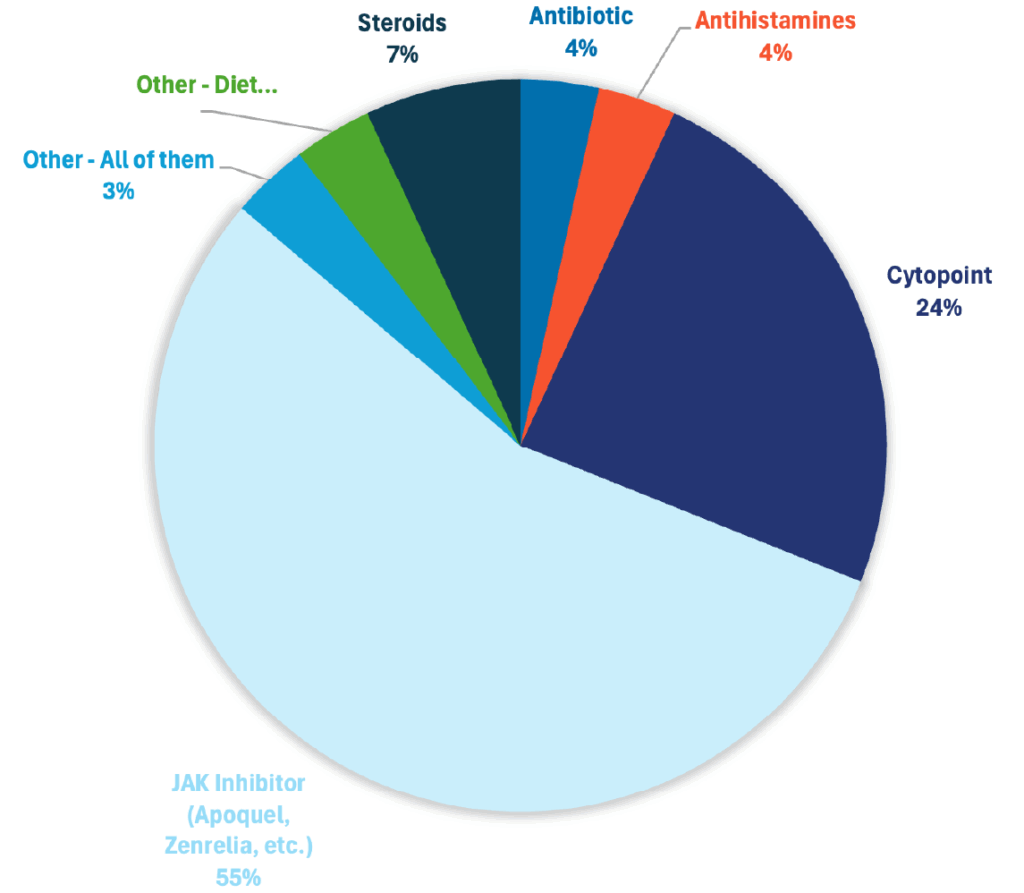
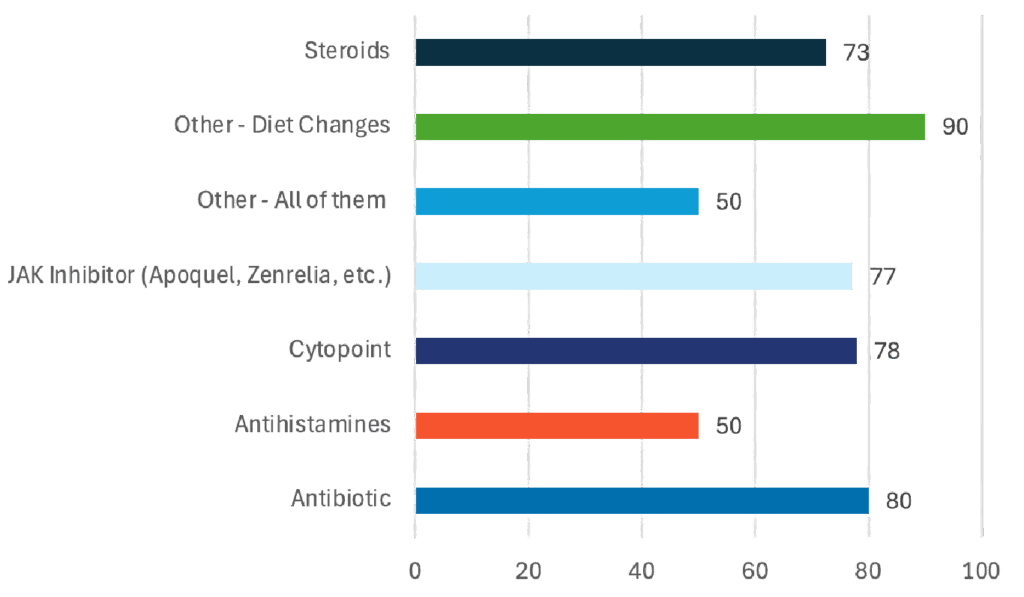
More than 55% of responding DVMs selected JAK inhibitors as their primary treatment for canine atopic dermatitis, reporting clinical effectiveness in roughly 77% of cases.

Atopic Dermatitis in Canines
Treatment Selections
Effectiveness
Specialists Insight
Atopic dermatitis is a complex condition that requires careful consideration of the patient’s clinical presentation, the owner’s involvement and ability to manage treatment, and the clinician’s expertise in determining the most effective course of care. Below, specialists perspectives on available treatment options along with supporting research to guide their recommendations.
1. Cytopoint (lokivetmab)
Efficacy Rating: 9/10
- Why: It’s a targeted injectable monoclonal antibody against IL-31 that provides fast relief (within 24 hours) and lasts 4–8 weeks on average. Minimal systemic effects make it especially suitable for long‑term management and dogs with comorbidities.
- How often it works without needing adjustment: ~70–80% of moderate cases achieve sustained relief for the full dosing interval.
2. JAK Inhibitors (e.g., Apoquel & Zenrelia)
Efficacy Rating: 8/10
- Why: Oral agents with very rapid onset—itch relief often starts within hours and full effect by ~24 hours—great for flare control. Zenrelia (ilunocitinib) offers once-daily dosing and similar efficacy.
- How often it works without adjustment: ~60–75% maintain disease control with consistent daily dosing.
3. Steroids (Glucocorticoids)
Efficacy Rating: 7/10
- Why: Highly effective and fast-acting, especially for acute flares, but long-term use is limited by well-known side effects.
- How often it works without adjustment: ~80–90% relief during short courses; longterm sustainability is lower due to side effect concerns.
4. Antihistamines
Efficacy Rating: 3/10
- Why: Very limited benefit in canine atopic dermatitis; may offer mild relief in a small subset of dogs, but generally not reliable as monotherapy.
- How often it works without adjustment: Likely <20% effective alone.
5. Diet Trial
Efficacy Rating: 4/10
- Why: Useful when food allergy is suspected. Can help identify triggers, but as a general first-line for environmental atopy, efficacy is low.
- How often it works without adjustment: ~25–35%, mostly in food-sensitive cases.
6. Other (Immunotherapy, Atopica, adjunct therapies)
Efficacy Rating: Varies (~6–8/10)
- Why: Allergen-specific immunotherapy (ASIT) addresses root cause and is highly effective long-term in many cases (~65% success). Steroid-sparing agents like cyclosporine or Atopica also play important roles in tailored plans.
- How often it works without adjustment: ASIT reaches ≥60% for long-term control; other strategies effectiveness varies by individual.
Essential Research Takeaways
Cytopoint (lokivetmab – Anti-IL-31 mAb)
- Shown to reduce pruritus quickly, with 94% success by Day 7 and sustained results.
- Blocks IL-31 to break the itchinflammation cycle; strong safety profile, even with repeated dosing.
- USDA-approved for atopic and allergic dermatitis since 2016.
JAK Inhibitors (Apoquel – oclacitinib, Zenrelia, Elanco)
- Provides rapid itch relief with long-term efficacy; often favored over steroids for side effect profile.
- Effective in most dogs, with up to 72% showing good control
- Backed by over 10 years of clinical data and critical reviews.
Steroids (Glucocorticoids)
- Rapidly relieve flares, best for short-term use; still widely used as a comparator to newer therapies.
Antihistamines
- Limited benefit as standalone therapy (<20% effective).
Diet Trials
- Useful when food allergy is suspected; less relevant for environmental atopy.
Other Treatments
- Allergen-specific immunotherapy and cyclosporine can be effective for longterm management, though sloweracting.
Protocol Relief Chart & Key Insights
| First-line Option | Efficacy Rating | Sustained Relief % |
|---|---|---|
| Cytopoint | 9/10 | ~70-80% |
| JAK inhibitors (Apoquel/Zenrelia) | 8/10 | ~60-75% |
| Steroids (short term) | 7/10 | ~80-90% (acute only) |
| Antihistamines | 3/10 | <20% |
| Diet Trial | 4/10 | 25-35% (if food-related) |
| Other (e.g., ASIT, cyclosporine) | ~6-8/10 | ~60-65% for ASIT; variable for others |
- Cytopoint is favored as the primary choice for moderate atopic dermatitis due to its rapid, long-lasting relief and safety profile.
- JAK inhibitors are a very effective oral alternative, ideal for flexibility and quick itch control.
- Steroids remain highly effective but are best reserved for flares due to systemic side effects.
- Antihistamines and diet trials are generally adjunctive, not primary monotherapies—except when food allergy is suspected.
- Immunotherapy (ASIT) is a valuable long-term solution for many dogs with proven allergen sensitivities.
| Treatment | Highlighted Evidence |
|---|---|
| Cytopoint | High success rates, sustained relief, strong safety profile |
| JAK inhibitors (Apoquel) | Rapid onset, effective in majority, good long-term data |
| Steroids | High effective for acute flares (common used in practice) |
| Antihistamines | Low standalone efficacy |
| Diet Trials | Useful for suspected food allergy; limited for environmental atopy |
| Other therapies (ASIT, etc.) | Effective long-term, less rapid--commonly used adjunctively |