

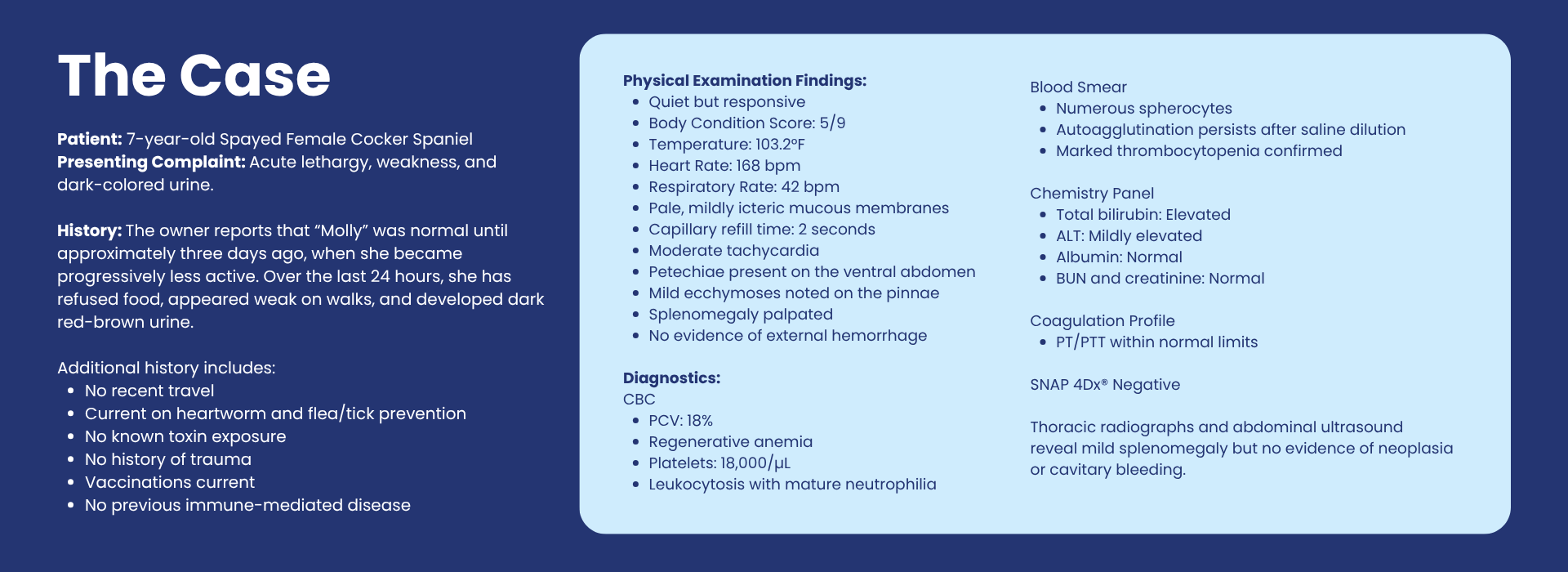
Clinical Question
What is your next recommendation?
- Begin prednisone therapy alone
- Administer a packed red blood cell transfusion, then begin prednisone
- Initiate aggressive immunosuppressive therapy with thromboprophylaxis and supportive care
- Begin doxycycline while awaiting infectious disease testing
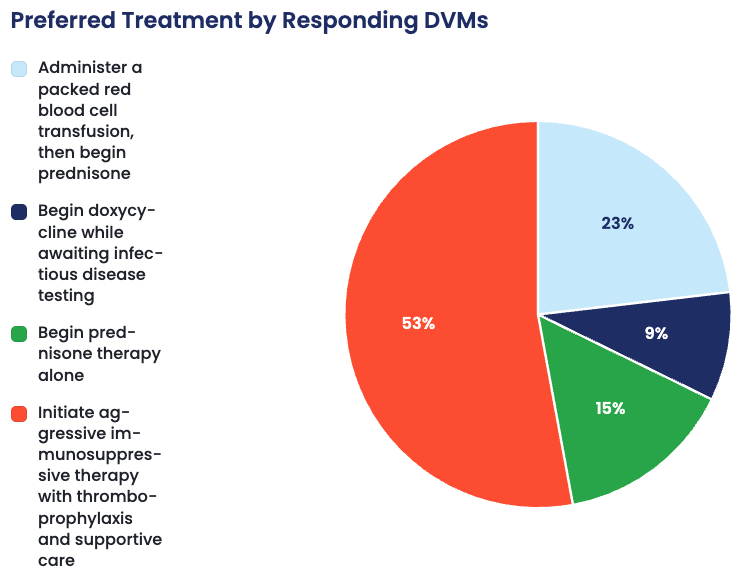
This week’s case showed strong alignment between practicing veterinarians and our specialists. Fifty-three percent of responding DVMs selected aggressive immunosuppressive therapy with thromboprophylaxis and supportive care—the same approach recommended by our internal medicine specialists. With severe regenerative anemia, marked thrombocytopenia, spherocytes, persistent autoagglutination, hyperbilirubinemia, petechiae, and ecchymoses, the findings strongly support Evans syndrome, where rapid control of immune-mediated destruction must be balanced against both bleeding and thromboembolic risk.
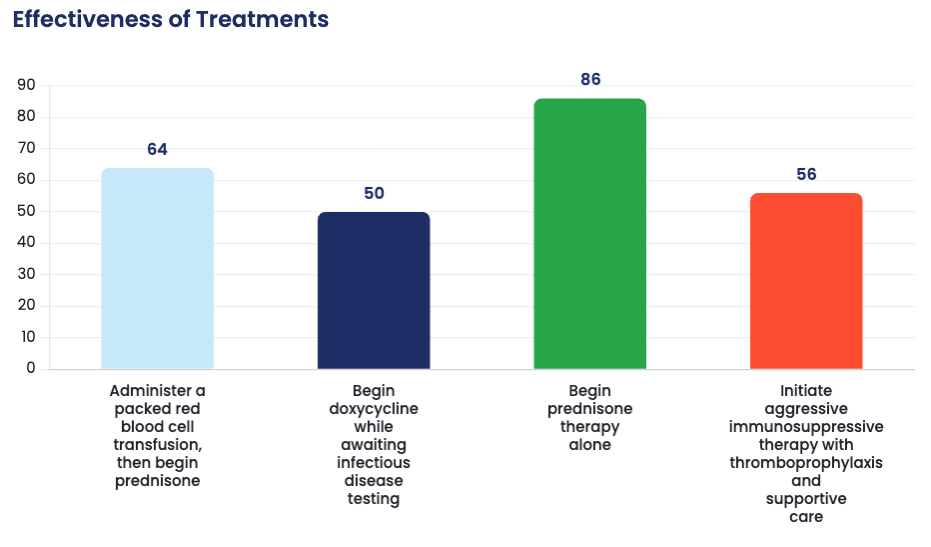
How a General Practitioner Might Approach This Case
This patient presents with two alarming problems. She is profoundly anemic. She is also severely thrombocytopenic. Either abnormality alone can be life-threatening. Together, they create one of the most challenging immune-mediated emergencies seen in small animal practice.
Many clinicians immediately focus on correcting the anemia through blood transfusion. Others begin high-dose corticosteroids as soon as immune-mediated hemolytic anemia (IMHA) is suspected. Some may hesitate, wondering whether an infectious disease such as ehrlichiosis or анапlasmosis could explain both abnormalities.
Each of these approaches has merit. However, specialists recognize that this case represents something more complex than uncomplicated IMHA.
How Specialists Typically View This Case
From an internal medicine perspective, the most appropriate recommendation is:
Initiate Aggressive Immunosuppressive Therapy with Thromboprophylaxis and Supportive Care
This patient is highly suspicious for Evans syndrome—the concurrent occurrence of immune-mediated hemolytic anemia (IMHA) and immune-mediated thrombocytopenia (ITP).
Although relatively uncommon, Evans syndrome carries a significantly higher mortality rate than either disease alone and requires rapid recognition and aggressive treatment.
Recognizing Evans Syndrome
The diagnosis is not based on a single laboratory value. Instead, it is the combination of findings that tells the story.
This patient demonstrates:
- Regenerative anemia
- Persistent saline agglutination
- Numerous spherocytes
- Hyperbilirubinemia
- Severe thrombocytopenia
- Petechiae and ecchymoses
Together, these findings strongly support simultaneous immune destruction of both red blood cells and platelets. Unlike simple blood loss, the body is actively destroying its own circulating cells.
Why Immunosuppression Must Begin Immediately
The primary disease process is immune dysregulation. Unless that immune response is interrupted, transfused red blood cells may also become targets for destruction. High-dose corticosteroids remain the foundation of treatment.
However, specialists frequently add a second immunosuppressive medication early in the course of disease, particularly in patients with severe thrombocytopenia or inadequate response to steroids alone.
Depending on the individual patient, this may include:
- Mycophenolate mofetil
- Cyclosporine
- Azathioprine (dogs only)
Early combination therapy has become increasingly common in referral practice.
The Often-Forgotten Complication
One of the greatest misconceptions about IMHA is that bleeding is the primary cause of death. In reality…Many dogs die from thromboembolic disease. The inflammatory cascade associated with IMHA creates a profoundly hypercoagulable state. Pulmonary thromboembolism remains one of the leading causes of mortality. This creates a difficult balancing act.
This patient has only 18,000 platelets/µL, raising concern for bleeding. Yet she simultaneously faces a substantial risk of life-threatening thrombosis. Specialists therefore individualize thromboprophylaxis based on the patient’s overall bleeding risk, platelet count trends, and clinical stability rather than applying a one-size-fits-all approach.
Why Not Prednisone Alone?
Prednisone remains the cornerstone of therapy. However, Evans syndrome often proves more aggressive than isolated IMHA.
Referral clinicians increasingly favor early multimodal immunosuppression because:
- Disease severity is greater.
- Relapse rates are higher.
- Response to corticosteroids alone may be slower.
The goal is rapid control of immune destruction before irreversible complications develop.
Why Not Simply Transfuse First?
Blood transfusions can absolutely save lives. This patient may ultimately require one depending on oxygen delivery, cardiovascular stability, and clinical signs. However, transfusion alone does not treat the underlying disease. Without immunosuppression, newly transfused erythrocytes may also be destroyed. Specialists view transfusion as supportive care—not definitive treatment.
Why Not Start Doxycycline?
Tick-borne diseases remain important differentials for anemia and thrombocytopenia. However, Molly receives routine parasite prevention.
Her SNAP testing is negative.
More importantly, the presence of:
- Spherocytes
- Persistent autoagglutination
- Hyperbilirubinemia
strongly supports immune-mediated hemolysis.
While infectious disease testing may still be pursued depending on geographic location, delaying immunosuppressive therapy while awaiting results could significantly worsen outcome.
Practical Application in General Practice
When evaluating dogs with suspected IMHA, specialists recommend asking four important questions.
Is thrombocytopenia also present?
Concurrent thrombocytopenia changes both prognosis and treatment strategy.
Are classic signs of immune-mediated hemolysis present?
Spherocytes, autoagglutination, regenerative anemia, and hyperbilirubinemia strengthen the diagnosis.
Is the patient at risk for thrombosis?
Even severely ill patients without obvious clot formation should be evaluated for thromboembolic risk throughout hospitalization.
Is supportive care enough?
Blood products, fluids, gastroprotectants, and nursing care remain essential—but none replace rapid immunosuppression.
Specialist Takeaway
This case illustrates how two immune-mediated diseases can occur simultaneously and dramatically increase patient risk. While correcting anemia often becomes the immediate focus, specialists recognize that controlling immune destruction is equally critical. At the same time, these patients must be monitored closely for one of the leading causes of mortality—thromboembolic disease.
For this reason, our internal medicine specialist recommends:
Aggressive Immunosuppressive Therapy with Thromboprophylaxis and Comprehensive Supportive Care
The broader lesson extends beyond Evans syndrome. When multiple laboratory abnormalities appear together, resist the temptation to treat each independently. Instead, ask whether they are manifestations of a single underlying disease process. Recognizing that connection often leads to faster diagnosis, more targeted treatment, and better patient outcomes.
References (MLA)
Garden, Olivia A., et al. “ACVIM Consensus Statement on the Diagnosis of Immune-Mediated Hemolytic Anemia in Dogs and Cats.” Journal of Veterinary Internal Medicine, vol. 33, no. 2, 2019, pp. 313–334.
Swann, J. W., and J. L. Skelly. “Systematic Review of Prognostic Factors for Mortality in Dogs with Immune-Mediated Hemolytic Anemia.” Journal of Veterinary Internal Medicine, vol. 27, no. 1, 2013, pp. 7–13.
Balch, Alex, and David M. Mackin. “Canine Immune-Mediated Hemolytic Anemia: Pathophysiology, Diagnosis, and Treatment.” Veterinary Clinics of North America: Small Animal Practice, vol. 45, no. 3, 2015, pp. 487–503.
Withrow, Stephen J., et al. Withrow & MacEwen’s Small Animal Clinical Oncology. 6th ed., Elsevier, 2020.