Which disease category shows the greatest variability in treatment outcomes within your practice?
- Dermatologic Disease
- Chronic GI Disease Specialist Corner
- Orthopedic Disease
- Cardiac Disease


As veterinary medicine continues to advance, our ability to diagnose and treat disease has never been stronger. Yet, even with modern diagnostics, specialty referral pathways, and evidence-based protocols, not all disease categories yield consistent outcomes. From a clinical outcomes standpoint, variability matters—it highlights where medicine is most complex, where personalization of care is critical, and where innovation and data collection can meaningfully improve patient lives.
When evaluating the question, “Which disease category shows the greatest variability in treatment outcomes within your practice?” four categories frequently emerge: dermatologic disease, chronic gastrointestinal (GI) disease, orthopedic disease, and cardiac disease. While each presents its own challenges, the category that consistently demonstrates the greatest variability in outcomes is chronic gastrointestinal disease.
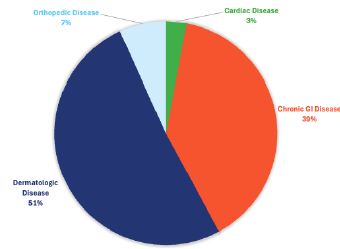
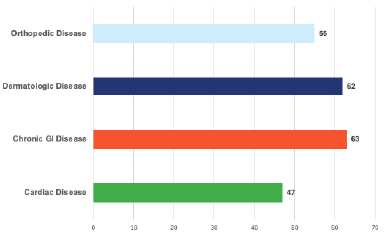
Responding DVMs were evenly split, with chronic GI disease and dermatologic disease emerging as the leading categories. From a specialist perspective, chronic GI disease typically shows greater variability in treatment response, driven by heterogeneous underlying etiologies and the frequent need for stepwise diagnostics and iterative therapeutic trials.
In assessing variability, we must first define the gold standard for predictable outcomes. Diseases with the most consistent results tend to share three characteristics:
When these factors are present—as they often are in orthopedic surgery or wellmanaged cardiac disease—outcomes become more predictable. Variability increases when diagnosis is multifactorial, treatment is iterative, and patient response is highly individualized.
Dermatologic conditions are common and, at times, frustrating—for both clinicians and pet owners. Outcomes can vary based on allergy triggers, secondary infections, and compliance with long-term management plans. However, advances in allergy testing, immunotherapy, targeted antimicrobials, and monoclonal antibody therapies (such as anti-IL-31 treatments) have significantly improved consistency.
While flares and relapses occur, dermatologic disease is often manageable rather than unpredictable. With proper diagnosis and client education, most patients achieve acceptable long-term control, placing dermatology in the midrange for outcome variability.
Overall variability: Moderate
Key driver: Owner compliance and environmental control
Chronic GI disease stands apart as the category with the widest spectrum of outcomes. This is due to several compounding factors:
Two patients with similar clinical signs may respond entirely differently to identical treatment plans. Additionally, long-term outcomes are heavily influenced by nutrition, microbiome health, owner adherence, and the patient’s immune response.
From a clinical outcomes perspective, chronic GI disease requires ongoing reassessment rather than a linear treatment plan, making variability inherent rather than exceptional.
Overall variability: High
Key driver: Individual biologic response and diagnostic ambiguity
Orthopedic conditions—particularly those requiring surgical intervention—often benefit from well-established standards of care. Procedures such as TPLO, fracture repair, and total hip replacement have predictable success rates when performed appropriately.
While outcomes can be affected by factors like patient size, age, comorbidities, and post-operative rehabilitation, the underlying pathology is typically well-defined, and success metrics are clear (pain reduction, return to function).
Orthopedics demonstrates high consistency when gold-standard care is delivered, with variability most often linked to external factors rather than medical uncertainty.
Overall variability: Low to moderate
Key driver: Surgical technique and post-operative management
Cardiac disease outcomes vary by diagnosis and stage, but within each condition, treatment pathways are increasingly standardized. Diseases such as degenerative mitral valve disease and dilated cardiomyopathy benefit from strong evidence-based protocols and objective monitoring tools (echocardiography, biomarkers, radiographs).
While cardiac disease can be progressive and life-limiting, outcomes are often predictable relative to disease stage, making variability more controlled compared to chronic GI disease.
Overall variability: Moderate
Key driver: Disease progression and timing of intervention
Chronic gastrointestinal disease represents the greatest opportunity—and challenge—in clinical outcomes. Its variability underscores the importance of:
Understanding where variability exists allows us to focus our efforts where patients stand to benefit most. By acknowledging the complexity of chronic GI disease and investing in better outcome tracking and shared clinical learning, the profession can continue to move toward more consistent, patientcentered care.
In the end, variability is not a failure of medicine—it is a signal pointing us toward where progress matters most.