

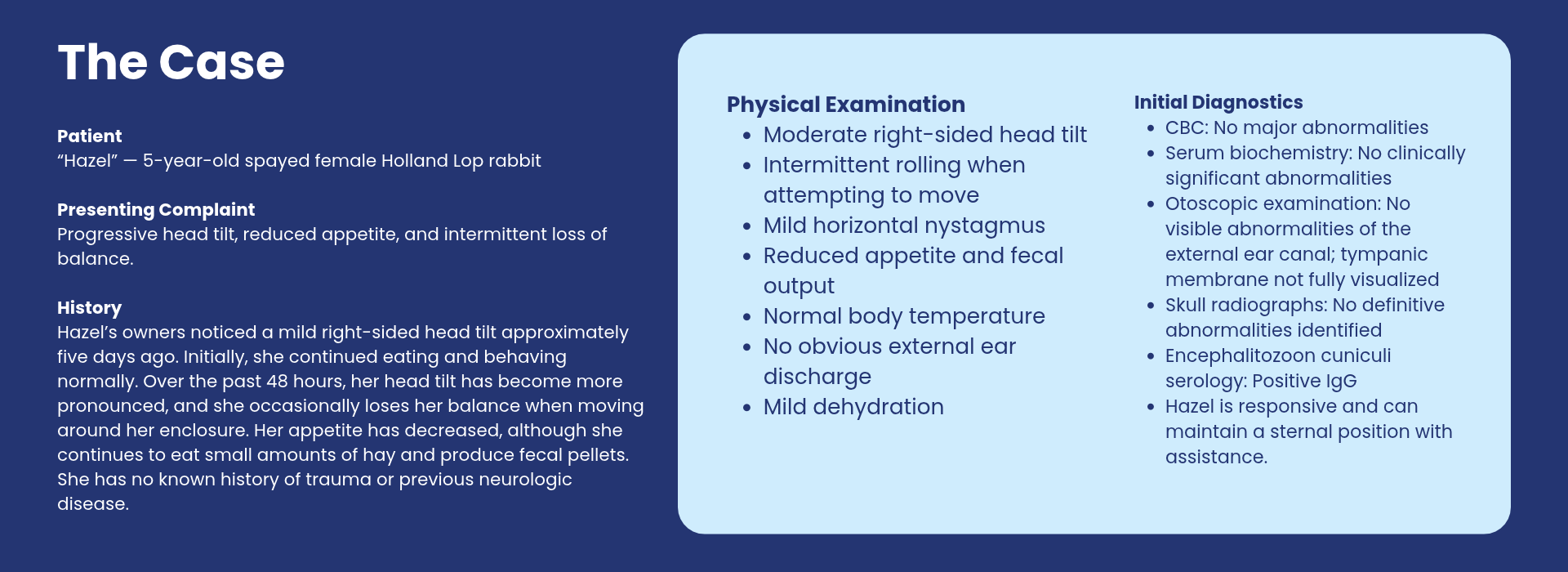
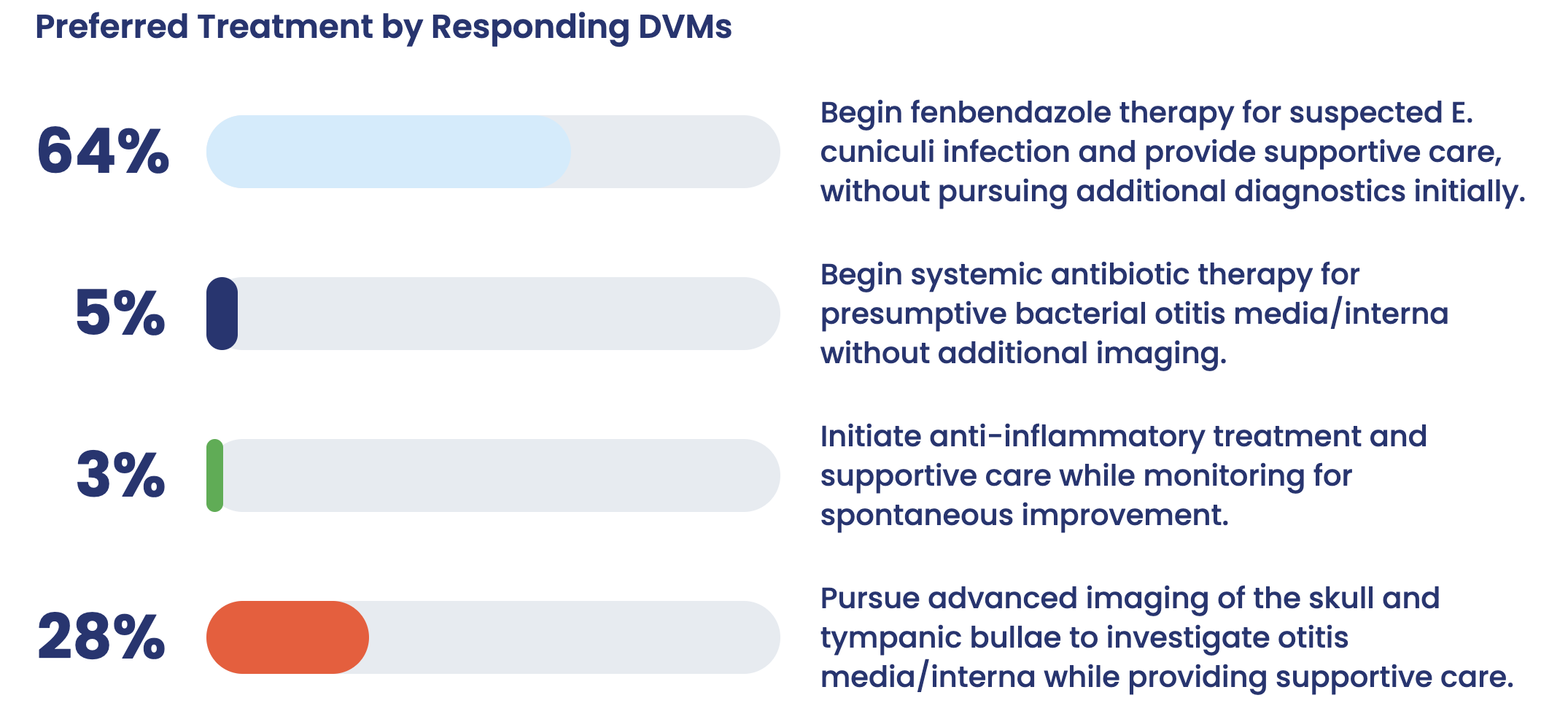
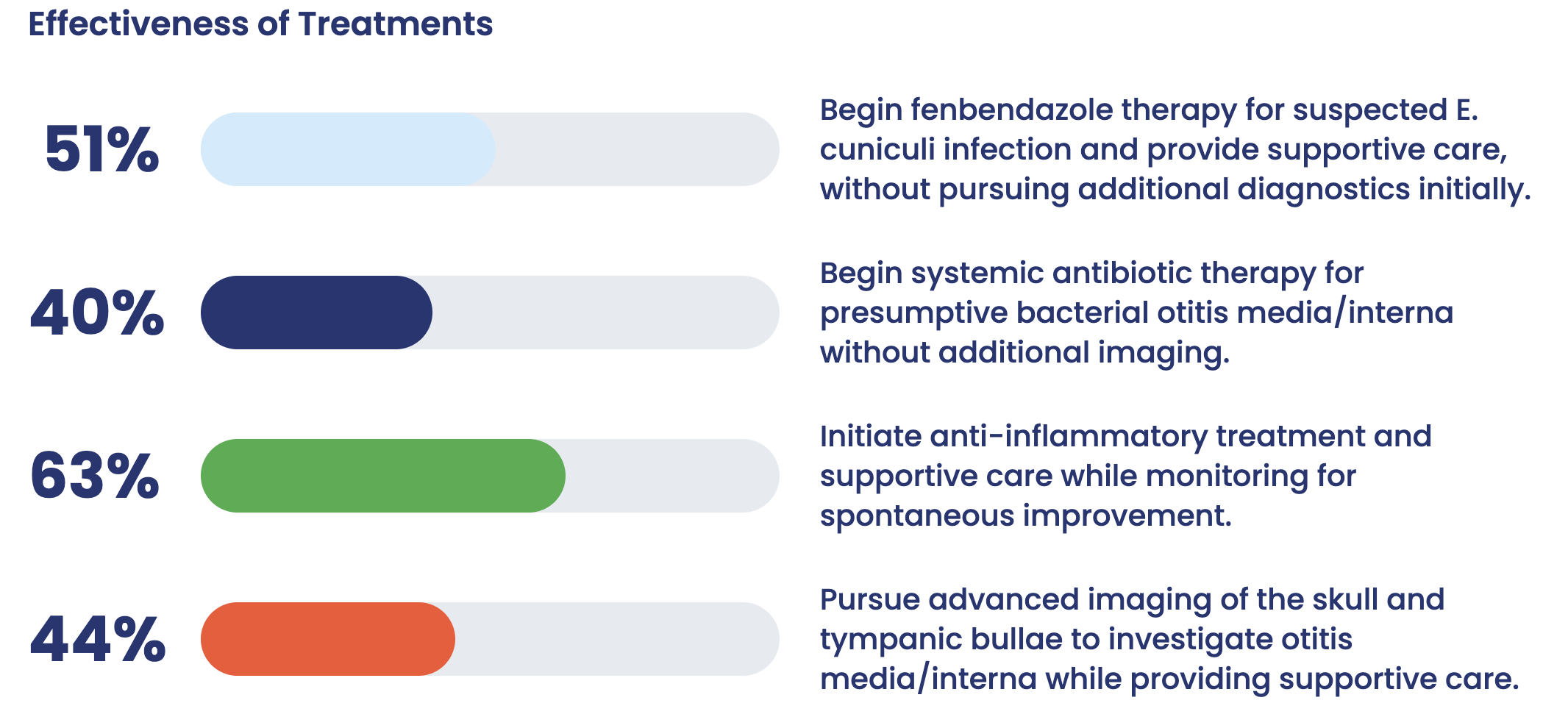
When faced with Hazel’s progressive head tilt, 64% of responding veterinarians chose to initiate fenbendazole therapy for suspected E. cuniculi without additional diagnostics, while 28% favored advanced imaging to investigate possible middle or inner ear disease. Interestingly, when asked to evaluate treatment effectiveness, respondents rated anti-inflammatory treatment and supportive care highest (63%), followed by fenbendazole (51%) and advanced imaging (44%).
These results highlight an important clinical consideration: When a rabbit presents with vestibular signs, are we considering all possible causes before deciding on treatment? Hazel’s case explores how general practitioners can balance diagnostic uncertainty, available resources, and practical treatment options when advanced imaging isn’t feasible.
The Clinical Takeaway: Treat the Patient, Not Just the Positive Test
When a rabbit presents with a progressive head tilt, two important diagnoses should be considered: Encephalitozoon cuniculi infection and bacterial otitis media/interna. Both can produce similar vestibular signs, and both may be present simultaneously.
While CT imaging provides a much more detailed assessment of middle and inner ear disease, it is not a realistic option for every client or general practice setting.
For most GPs, the practical approach is to complete the diagnostics available in the hospital, provide immediate supportive care, and consider empiric treatment for both parasitic and bacterial disease when the clinical presentation warrants it and definitive testing is not feasible.
Three clinical principles should guide that decision:
- Don’t stop at E. cuniculi. A positive antibody result does not prove that the parasite is responsible for the rabbit’s neurologic signs. Middle or inner ear infection must remain an important differential.
- Understand what your diagnostics can and cannot tell you. Physical examination, serology, bloodwork, and skull radiographs can help narrow the possibilities. CT is substantially more sensitive for detecting middle ear abnormalities, but even CT findings require clinical interpretation.
- Treat empirically when necessary. If referral or advanced imaging is not feasible, treatment should address the most likely causes based on the patient’s presentation, clinical findings, and response to initial therapy.
A 2024 retrospective study of 73 rabbits presenting with head tilt found that E. cuniculi-associated disease and otitis media/interna were the most common identified causes, including rabbits affected by both conditions. This reinforces why a single positive test should not determine the entire treatment plan.
What Does This Mean for Hazel?
Hazel, a 5-year-old spayed Holland Lop, presents with progressive right-sided head tilt, intermittent rolling, horizontal nystagmus, decreased appetite, and reduced fecal output. Her E. cuniculi IgG is positive, but her initial ear examination and skull radiographs have not identified an obvious cause.
The concern is that Hazel’s positive serology may lead to premature treatment for E. cuniculi alone, potentially overlooking an underlying bacterial ear infection.
Her progressive vestibular signs and lop-ear conformation make middle or inner ear disease an important consideration, even without visible discharge or abnormalities on routine radiographs.
For Hazel, treating suspected E. cuniculi while also considering empiric systemic antimicrobial therapy for possible otitis media/interna is a reasonable GP approach when further diagnostics are unavailable, provided medication selection is appropriate for rabbits and supported by the clinical assessment.
This approach does not establish a definitive diagnosis. It acknowledges the limitations of general practice diagnostics while addressing two plausible, treatable causes of her symptoms.
The General Practitioner’s Approach: What Can Be Done in Clinic?
A GP does not need access to advanced imaging to begin making meaningful treatment decisions. The priority is to establish a reasonable differential list, stabilize the patient, and make informed decisions using the resources available.
- Start with a practical diagnostic workup
A thorough physical and neurologic examination should help determine whether the findings suggest peripheral or central vestibular disease.
Initial diagnostics may include:
- CBC and serum biochemistry: Evaluate systemic health, hydration concerns, renal function, and factors that may influence treatment.
- E. cuniculi serology: Assess evidence of exposure or infection. A positive IgG alone does not confirm active disease; paired testing or IgM may provide additional context.
- Otoscopic examination: Look for ear canal abnormalities, discharge, or inflammation, recognizing that middle ear disease can be present without visible external changes.
- Skull radiographs: Evaluate for obvious bulla abnormalities or structural changes, understanding that normal findings cannot exclude middle or inner ear disease.
When available, CT of the skull and tympanic bullae is the preferred imaging option for assessing suspected middle ear disease. However, it should be presented as the next diagnostic option when accessible, not a prerequisite for treatment.
Even CT cannot independently confirm that an identified abnormality is the cause of the vestibular signs, and it cannot definitively establish active E. cuniculi infection.
- When CT isn’t an option, consider treatment for both leading differentials
If Hazel’s family declines advanced imaging or referral is unavailable, the GP must make a treatment decision based on the evidence currently available.
For suspected E. cuniculi, fenbendazole is commonly used, although evidence regarding its effectiveness in established neurologic disease remains limited. Treatment decisions should account for the patient’s overall condition and appropriate monitoring.
For suspected bacterial otitis media/interna, systemic antimicrobial therapy may be appropriate, particularly when progressive vestibular signs cannot otherwise be explained. Selection should account for rabbit-specific drug safety, likely pathogens, and culture results when obtainable. Oral administration of certain antibiotics can cause serious gastrointestinal complications in rabbits.
Empiric treatment for both conditions may be justified when both remain plausible and the patient’s symptoms are progressing. However, dual therapy should not be automatic for every rabbit with head tilt. It should reflect the clinical assessment and a discussion of the benefits, limitations, and risks with the client.
Supportive care is equally important. For Hazel, reduced appetite, declining fecal output, and rolling present immediate concerns. Fluid support, nutritional assistance when safe, appropriate analgesia, and a padded, low-stress environment should be addressed alongside disease-specific treatment.
- Reassess the patient and adjust the plan
When treatment begins without a definitive diagnosis, follow-up becomes an essential part of clinical decision-making.
The GP should monitor Hazel’s appetite, fecal production, hydration, head tilt, balance, and ability to move safely. Early reassessment is especially important given her declining food intake and progressive clinical signs.
Continued deterioration, an inability to maintain nutrition or hydration, new neurologic deficits, or inadequate response to treatment should prompt reconsideration of the diagnosis and renewed discussion of referral.
Clinical improvement can support continued treatment, but it does not prove which disease was responsible, particularly when multiple therapies were initiated.
Where an Exotics Specialist May Take the Case Further
An exotics specialist would share the GP’s initial concerns about E. cuniculi and bacterial otitis media/interna. The difference lies primarily in the ability to investigate these possibilities further and tailor treatment based on additional findings.
CT imaging can help identify middle ear abnormalities that are not visible on radiographs. Depending on the findings, a specialist may recommend middle ear sampling for bacterial culture and susceptibility testing, additional serologic evaluation, or MRI if central neurologic disease is suspected.
These diagnostics can be especially valuable when the rabbit fails to improve, deteriorates despite treatment, or develops recurrent vestibular episodes.
For refractory middle ear disease, surgical intervention may also be considered. However, these options should be guided by the patient’s condition, expected benefit, and the client’s resources rather than presented as requirements for every case.
The Bottom Line: Good Medicine Doesn’t Always Require Advanced Diagnostics
Hazel’s case illustrates a common challenge in general practice: the ideal diagnostic pathway is not always the most accessible one.
A positive E. cuniculi test should not end the investigation, and a normal ear examination should not eliminate bacterial infection from consideration.
For the GP, the goal is to recognize both possibilities, use available diagnostics to guide clinical judgment, initiate appropriate treatment when necessary, and reassess the patient’s response.
Advanced imaging can reduce diagnostic uncertainty, but when it isn’t available, thoughtful empiric treatment and close monitoring remain important tools for managing these patients.
Veterinary Medical Research References
These sources support the diagnostic and treatment principles discussed above.
- Liatis T, et al. (2024). Otitis media/interna and encephalitozoonosis are the most common causes of head tilt in pet rabbits in the UK: 73 cases (2009–2020). Veterinary Record. Read study
- de Matos R, et al. (2015). Computed tomographic features of clinical and subclinical middle ear disease in domestic rabbits: 88 cases. Journal of the American Veterinary Medical Association. This study is referenced in the original article and supports CT evaluation of middle ear abnormalities.
- MSD Veterinary Manual. Parasitic Diseases of Rabbits. Covers interpretation of E. cuniculi diagnostics, fenbendazole use, and treatment limitations. Read veterinary reference
- Merck Veterinary Manual. Bacterial and Mycotic Diseases of Rabbits. Reviews bacterial otitis media/interna, antimicrobial management, and referral considerations. Read veterinary reference
Disclaimer: The mentioned insights reflect specialist-level perspectives informed by published veterinary research, clinical guidelines, and established standards of care. They are intended to provide additional clinical context and may not represent the direct opinion of an individual veterinary specialist.